

What do Americans want from the immigration system? And does the government deliver?
There have been a few great posts about this recently1 approaching this question from different angles. Today I’m consolidating a few of these threads into four basic stylized facts.
1. The US gets more immigrants than the American public wants.
Laurentz Guenther points this out clearly in his great recent post, showing that “For decades, US citizens have demanded a reduction in immigration flows.” It has long been the case that more voters want immigration decreased than increased.
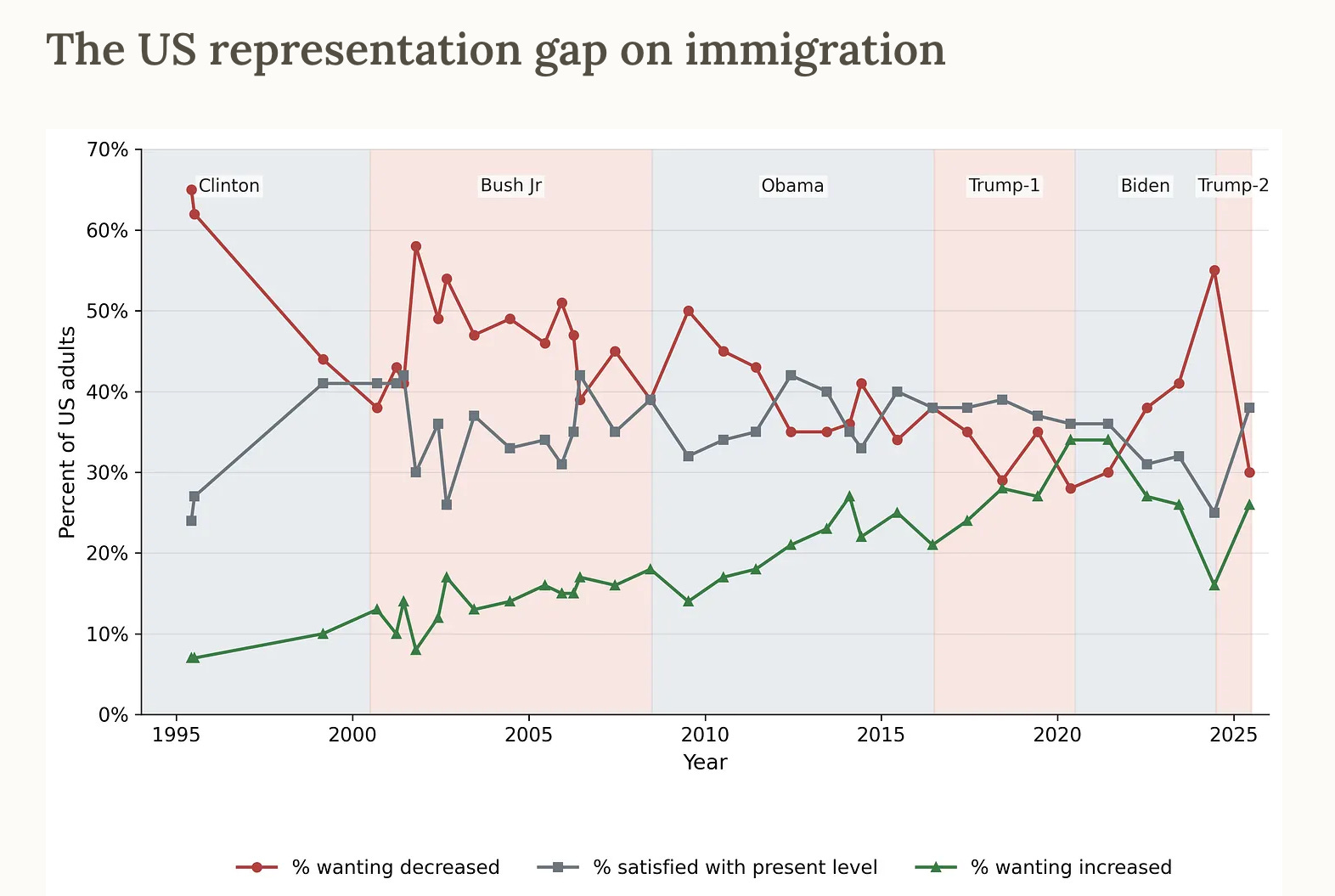
Why hadn’t one of the parties moved earlier to reduce immigration then? Because elites from both parties like immigration more than the American public. Relative to the typical voter, elites are both more cosmopolitan, and more likely to understand the economic contributions of immigrants.
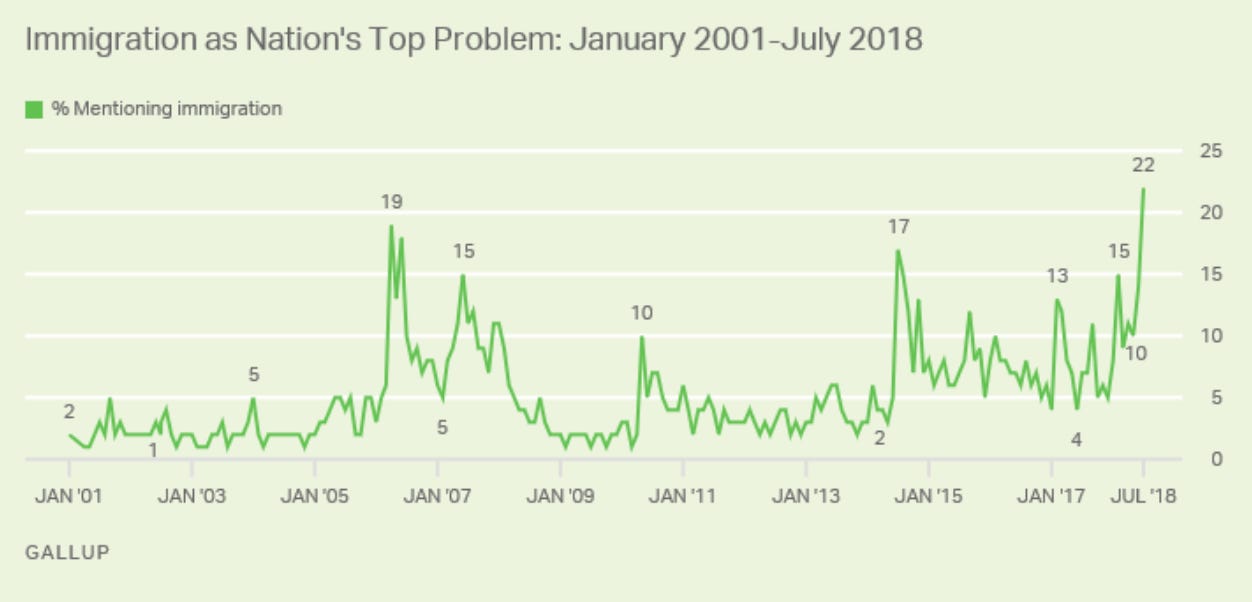
2. Americans have tolerated this because immigration wasn’t an important issue until the late 2000s.
Historically, immigration was just not an issue that most Americans cared that much about. At the turn of the millennium, only 2% of voters said immigration was the nation’s top problem. This started changing in the late 2000s, and was consistently between 5-10% during the 2016 election.
To understand why people got more worried about immigration, all you have to do is look at increase in the number of illegal immigrants from 1990-2010:
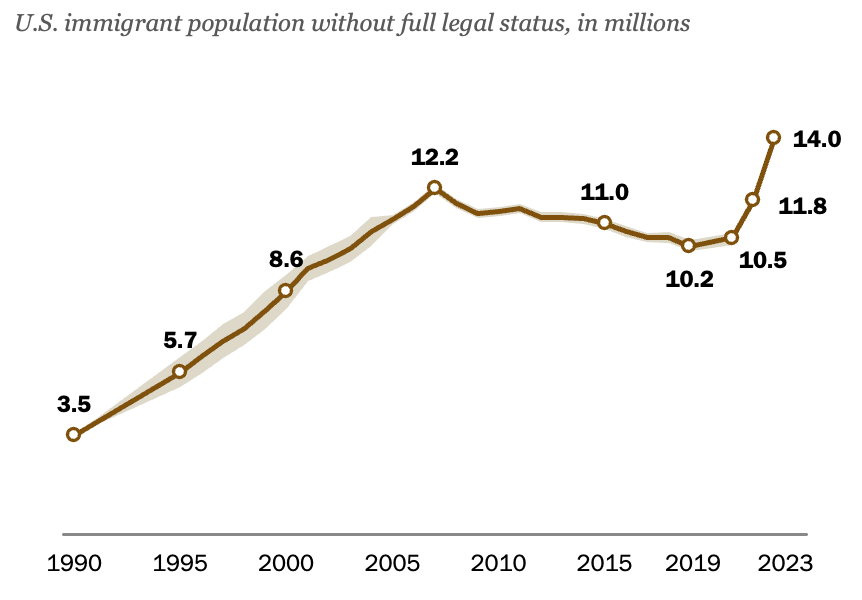
With that context, it’s extremely reasonable to understand why immigration has become more important to voters over the past few decades.
3. Trump 2.0 is giving the people what they want: Reducing illegal immigration.
Trump has talked about reducing illegal immigration for his whole political career, but actually didn’t do much at all in his first administration. But this time around Trump has actually achieved net decrease in unauthorized immigrants.
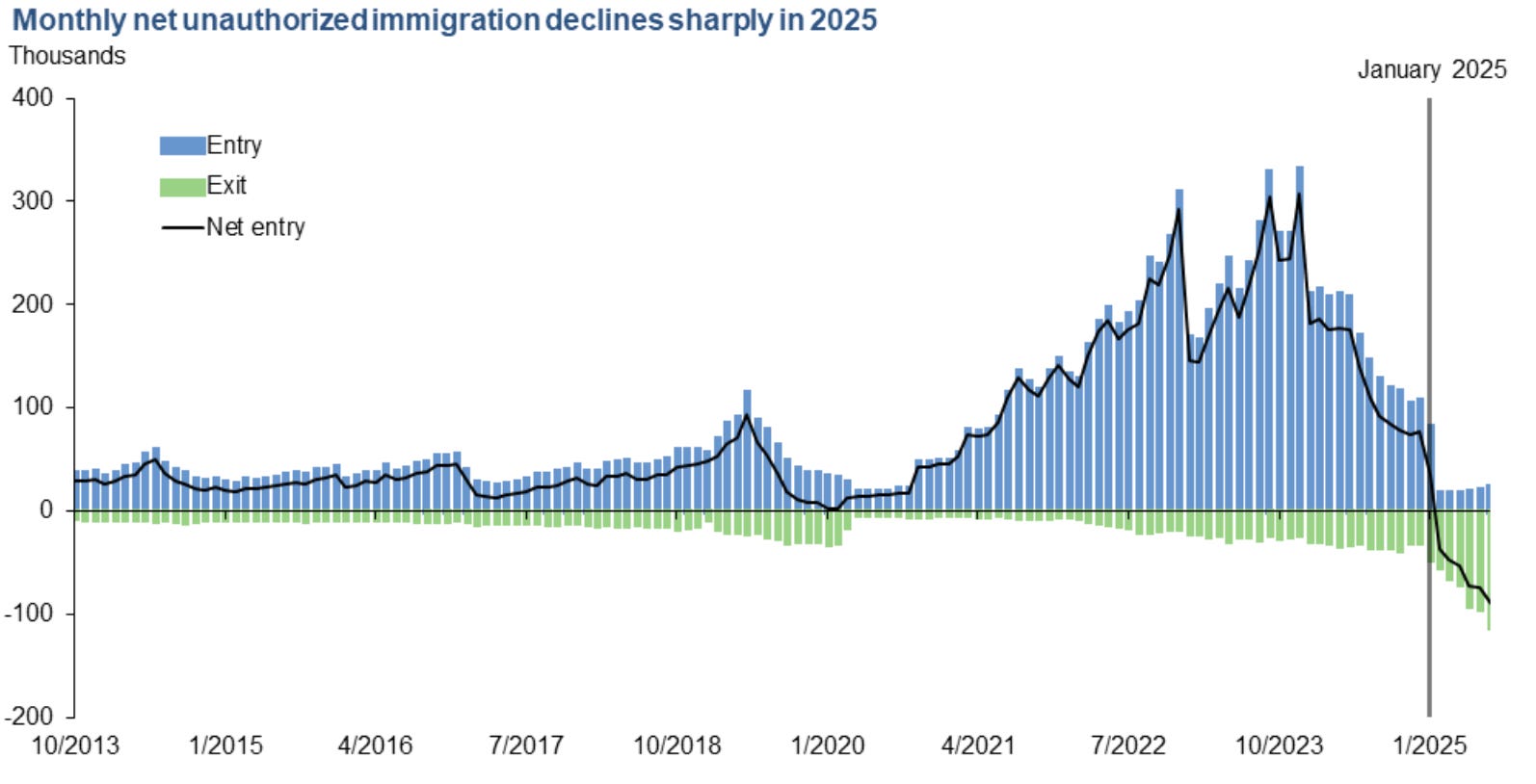
Just read Guenther’s piece if you want to learn more here.
4. Voters still like high-skilled immigration.
People (myself and the Trump admin included) often talk about immigration as if it is a monolithic thing. It is not. There are many different types of immigration, and voters have different opinions accordingly2. For one thing, high skilled immigration is popular while illegal immigration is not.
The Trump administration realizes this. They obviously talk a big talk about criminals and deportations, but Trump and Rubio will also occasionally say how the US should attract the world’s smartest people.
The White House is, however, not very well organized on this issue, as is clear from the constant rollouts and walkbacks, and the unpopularity of their actions on green cards and high-skilled immigration.
Synthesis: Reduce illegal immigration, improve high-skill immigration
A more coherent strategy from the Trump administration (or really from any administration who wants to win these issues) would have the government play two roles simultaneously:
The Bouncer - crack down seriously on illegal immigration. Build the wall, stop overstays, do some deportations. Some of this will work, some of it will just score brownie points with voters. But overall, you get across the idea that if you want to come to the US, you have to follow the rules.
The Recruiter - improve our ability to attract high-skilled immigrants. Reform the H-1B program. Keep letting skilled folks use the O-1A. And stop issuing confusing statements that are immediately walked back.
For now, at least, we are in a political economy regime where the public cares about immigration. This means, rather than tracking the desires of elites, immigration policy needs to more-closely track what voters actually want. These two pillars could be the core of an immigration strategy that would be popular, economically beneficial, and rebuild trust with the public that immigration makes us all better off.
From Alexander Kustov, Laurentz Guenther, and Hanno Hilbig. All of these pieces are part of the ongoing intellectual project to build immigration policy that is in the interest of voters, which Kustov is the standard-bearer for.
Thanks, great post! I agree.
One thing that came to my mind: the US had a similar immigration crisis in the early 20th century, which culminated in the Immigration Act of 1924. It may be useful to compare this past sequence of events to what is happening now.
Nothing in this post is wrong, but as someone who is friends with many (legal) immigrants and was in a relationship with one for a long time, I feel like it elides that there is _some_ tradeoff between recruitment and enforcement.
What I have repeatedly heard during both Trump administrations is the constant low-level fear that immigrants have, that they may have messed up crossing a single t or forgotten to check some box, or even that they just get misidentified or mistaken, and they suddenly fall in the unforgiving “illegal” pile with no recourse. Some say this gave them active second thoughts about staying, and I wouldn’t be surprised if it changed people’s behavior at the margin.
A very harsh bouncer does make the job of a recruiter (or to keep the analogy the same, a promoter) more difficult, even if voters want both and both have a role to play.