
The US has lost control of its borders. Voters fear that foreigners are not properly integrating into American society. Washington cracks down on illegal immigration and slashes refugee admissions. This sounds like a description of America today, but it also describes America in the early 1980s.
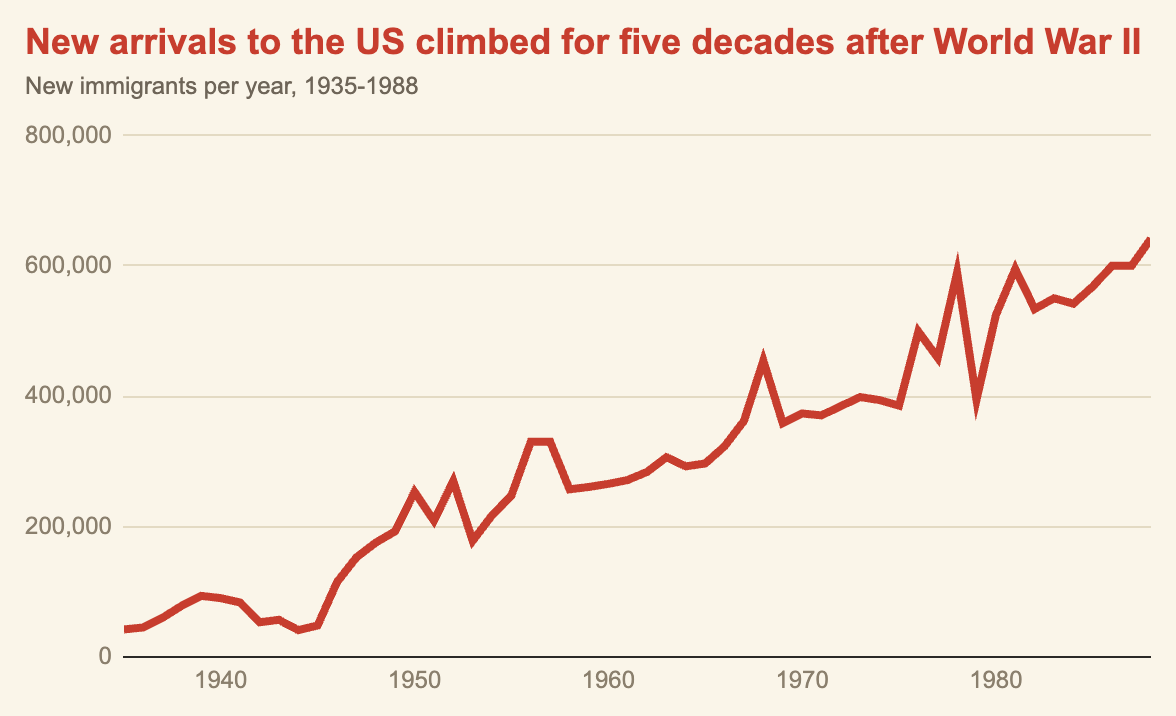
In the decades following World War II, America progressively opened up to an ever-growing and increasingly global stream of migrants and refugees. By the 1980s, with illegal immigration a major political issue and widespread anxieties about assimilation, many Americans wanted their country’s gates closed.
Which makes it all the more surprising that Congress passed the Immigration Act of 1990, opening those gates even wider.
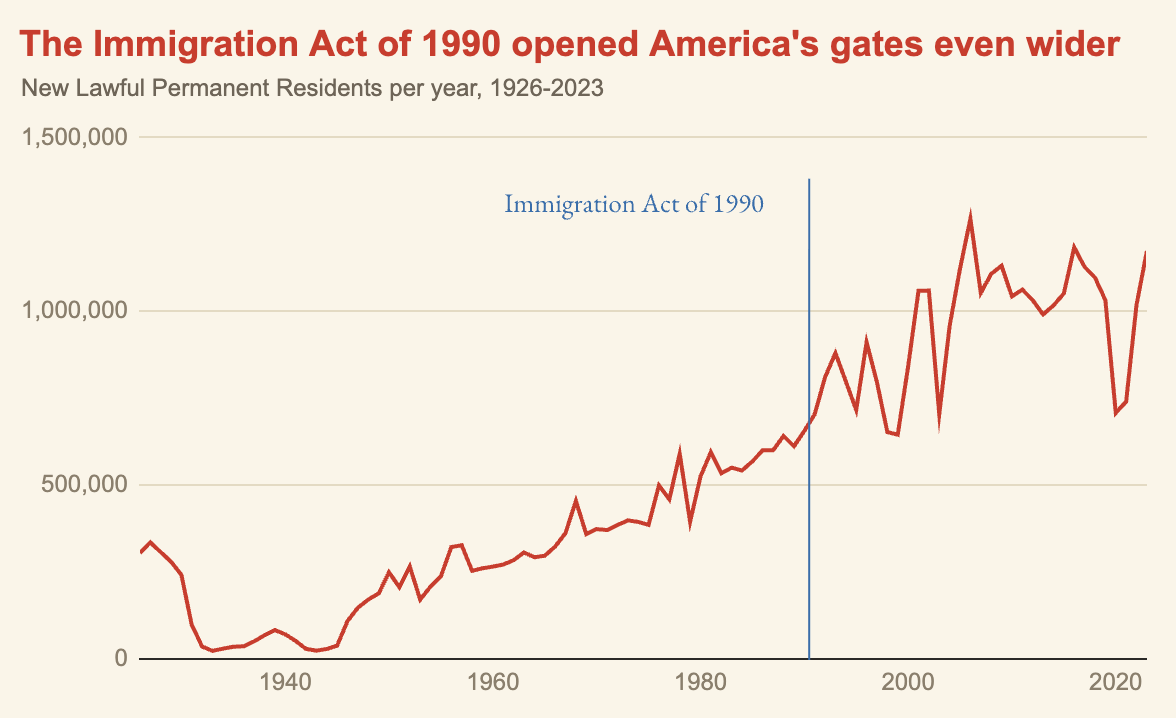
The act increased limits on existing immigration, created new categories out of whole cloth, and introduced the employment-based immigration system we still use today. Congress passed it with bipartisan support at a time when nearly half of the U.S. population wanted immigration to decrease.
Immigration reform has floundered ever since.
In this post, I’m going to explore the lessons of the Immigration Act of 1990. Its passage reveals the limits of public opinion in shaping policy direction.
But perhaps more importantly, it teaches those of us who want to make immigration a source of strength for the nation that we must accept that illegal immigration must be controlled. It is not enough to open the front door - we must also close the back door.
Civil Rights leaders summon ICE, Republican presidents summon refugees
Increasing immigration was the opposite of what the public wanted in 1990. Around the time of the 1990 act, the number of people who wanted less immigration approached 50%.
At the same time, immigration reached levels higher than most Americans had ever seen in their lifetimes.
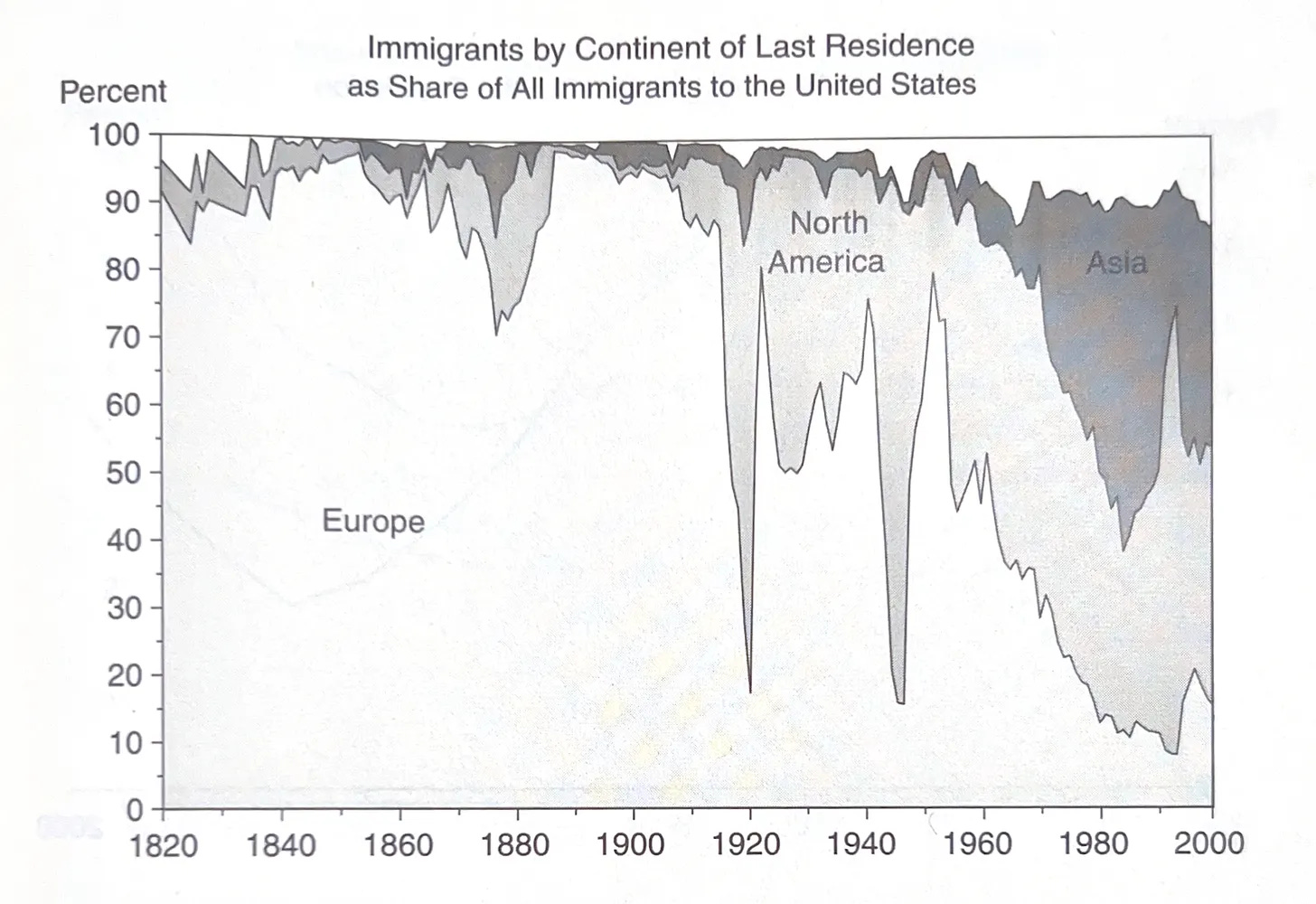
And not only was immigration higher than ever, but immigrants increasingly hailed from non-European nations.
The public, fairly or unfairly, fretted about cultural assimilation of these new immigrants, worrying “that the country’s assimilative capacities [were] overtaxed, or indeed, that its character [was] imperiled by the preponderance of non-white, Spanish-speaking newcomers.”1
Amplifying this sense of discomfort was the rise in the 60s and 70s of mass illegal immigration. The Bracero program, which had previously allowed Mexican workers to fill agricultural labor shortages, ended in 1965. With their legal supply of workers cut off, employers responded by hiring illegal immigrants en masse.
People did not like this.
So much so that in 1968, labor and civil rights leader Cesar Chavez urged Congress to send the INS to deport illegal immigrants.
This is a revered Mexican-American labor organizer, leftist activist, and folk hero calling the equivalent of ICE to deport migrant farmworkers. That this is unimaginable today is a measure of how completely immigration’s ideological lines have been redrawn.
Immigration was also an addictive elixir for Cold War presidents seeking to trumpet the allure of capitalism. To name a few examples:
1968: Nixon let in ~50,000 Czechoslovakians after the USSR invaded Prague.
1975: Ford welcomed ~130,000 refugees from South Vietnam, Laos, and Cambodia.
1980: Carter’s Mariel Boatlift allowed 125,000 Cubans to come to Florida.
The overall picture here is one in which forces both for and against immigration cut across party lines. Democrats supported labor, but also had important constituencies among minority groups. Business-friendly Republicans valued the economic benefits of immigration but worried about cultural assimilation. And both parties saw immigration as a valuable Cold War weapon.
There was no single pro-immigration coalition. If immigration reform was to pass, Congressional leaders would need to manufacture a majority by giving different groups different reasons to vote yes.
Building the coalition: A lawyer, a Kennedy, and a priest walk into a Select Commission
In the late 1970s, the Democrats controlled Congress and the presidency. Ted Kennedy, brother of John and Robert, and a Democrat from Massachusetts, stood among those who wanted to reform immigration.
Doing so would require charting a course that had the support of not only Republicans but also warring factions within the Democratic Party. They were caught between two important constituencies: Mexican-American groups who viewed immigration restriction as a step towards discrimination, and labor organizers who didn’t want foreign employees undercutting union wages.
Kennedy sought to solve this problem by creating ideological middle ground in the form of the Select Commission on Immigration and Refugee Policy (SCIRP).
Congress commissioned SCIRP in 1978 as a nonpartisan committee to study immigration and develop potential policy solutions. Along with Cabinet members, labor leaders, and civil rights activsts, it included:
Kennedy himself
Senator Alan Simpson, a lawyer by trade and a Republican from Wyoming
Father Theodore Hesburgh, a Catholic Priest and President of Notre Dame.
Kennedy and Simpson ended up sponsoring the Immigration Act of 1990, and Father Hesburgh was one of its most vocal public supporters.
SCIRP worked for 2 years, conducting public hearings, site visits, and consolidating academic research. Its final report ran to nearly 500 pages, and gave numerous recommendations on how to improve the US’s immigration system, which they summed up as follows:
“We recommend closing the back door to undocumented/illegal migration, [and] opening the front door a little more to accommodate legal migration”
This “close the back door / open the front door” formula built the elite consensus that served as the template for Congress’s major immigration action for the next 10 years.
IRCA in 1986: Closing the back door (or at least appearing to)
The first step was to close the back door. Congress attempted to do so with the Immigration Reform and Control Act of 1986.
IRCA aimed to tackle illegal immigration by requiring employers to enforce legal-status checks for their employees. It also allocated more staff and funds towards border enforcement, and created the seasonal agriculture program in an attempt to reduce reliance on illegal immigration2.
It essentially failed in these efforts. The Reagan and first Bush administrations were notably nonchalant about enforcing employer sanctions, and the beefed-up border procedures were ultimately insufficient to reduce illegal entries3.
By 1989 it was already clear that the effort to reduce illegal immigration had not worked4. We still live with its failures today, with record-high levels of illegal residents.
But even merely attempting to tackle illegal immigration established Congressional authority to now turn towards improving legal immigration5.
The Immigration Act of 1990: Opening the front door
The Immigration Act of 1990 completed the second (and more effective) step of opening the front door.
The act’s eventual passage was a triumph of political compromise and coalition-building, based on the intellectual framework laid out by SCIRP. Three types of arguments interlocked to create a stable coalition of support for the bill:
Economic: Using immigration as an economic lever to increase global competitiveness.
Diversity: Increasing migration opportunities from countries currently poorly-represented among US immigrants.
Family: Expanding existing family-based pathways.
Economic arguments appealed to business-minded Senators, particularly Republicans, and were bolstered by growing intellectual consensus that a skilled workforce was critical to the nation’s future6. Employment-based arguments also helped secure the support of the strongly pro-business Bush White House.
Diversity, interestingly, appeared in the debate at the behest of Irish-American associations desirous of more Irish immigrants. In some drafts of the 1990 bill, there were even carve-outs for Irish nationals. However, ultimately these concerns were largely implemented via the diversity visa instead.
Groups with entrenched interest in existing family-based pathways threw their weight around as well. The American Immigration Lawyers Association (AILA) lobbied to ensure that new employment-based green cards didn’t reduce the pool of family-based green cards. They were joined by Asian, Hispanic, and Italian immigrants’ rights groups lobbying for the expansion of family-based admissions.
In the end, the turkey had enough feathers to satisfy all these groups. The Immigration Act of 1990 passed with bipartisan support: 89-8 in the Senate, 264-118 in the House. President Bush signed it into law on November 29, 1990.
The impact of the 1990 law
The Immigration Act of 1990 significantly reshaped both the quantity and quality of US immigration.
The 1990 act significantly shifted the composition more towards skills and employment-based visas, although numerically US immigration still skews heavily towards families7.
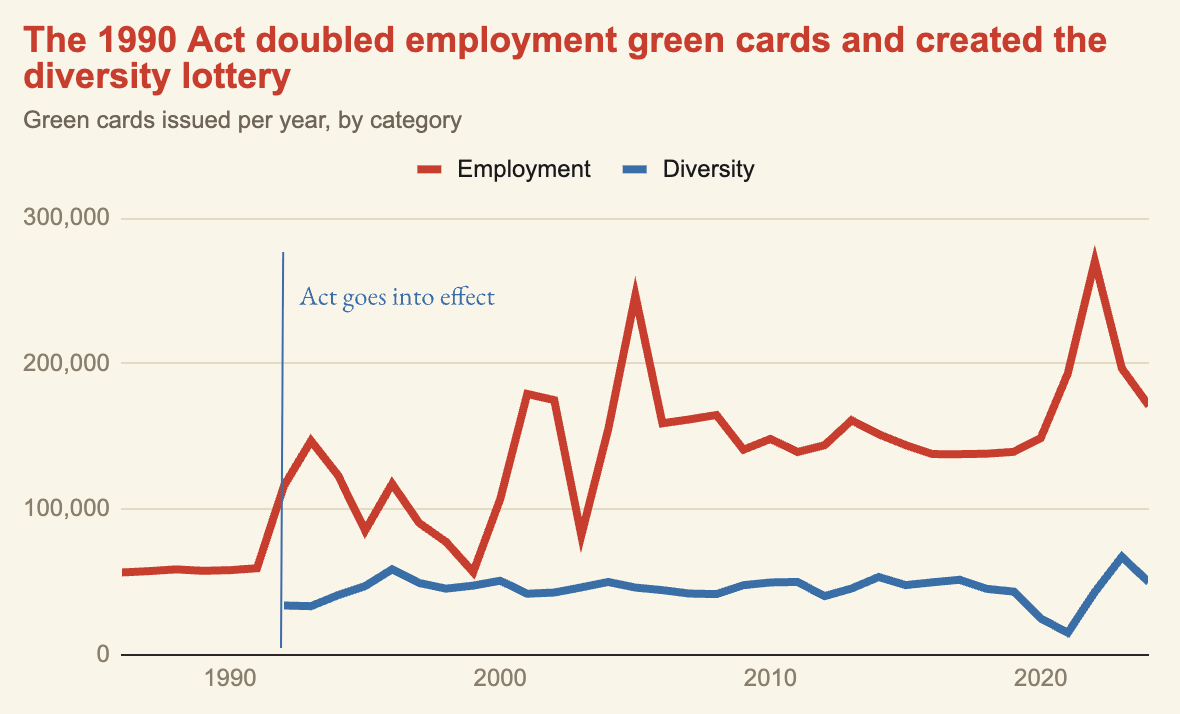
It grew the number of employment-based green cards8 granted each year from ~50k to ~140k, added ~50k diversity visa slots, while also adding almost 200k new family-based green card slots9.
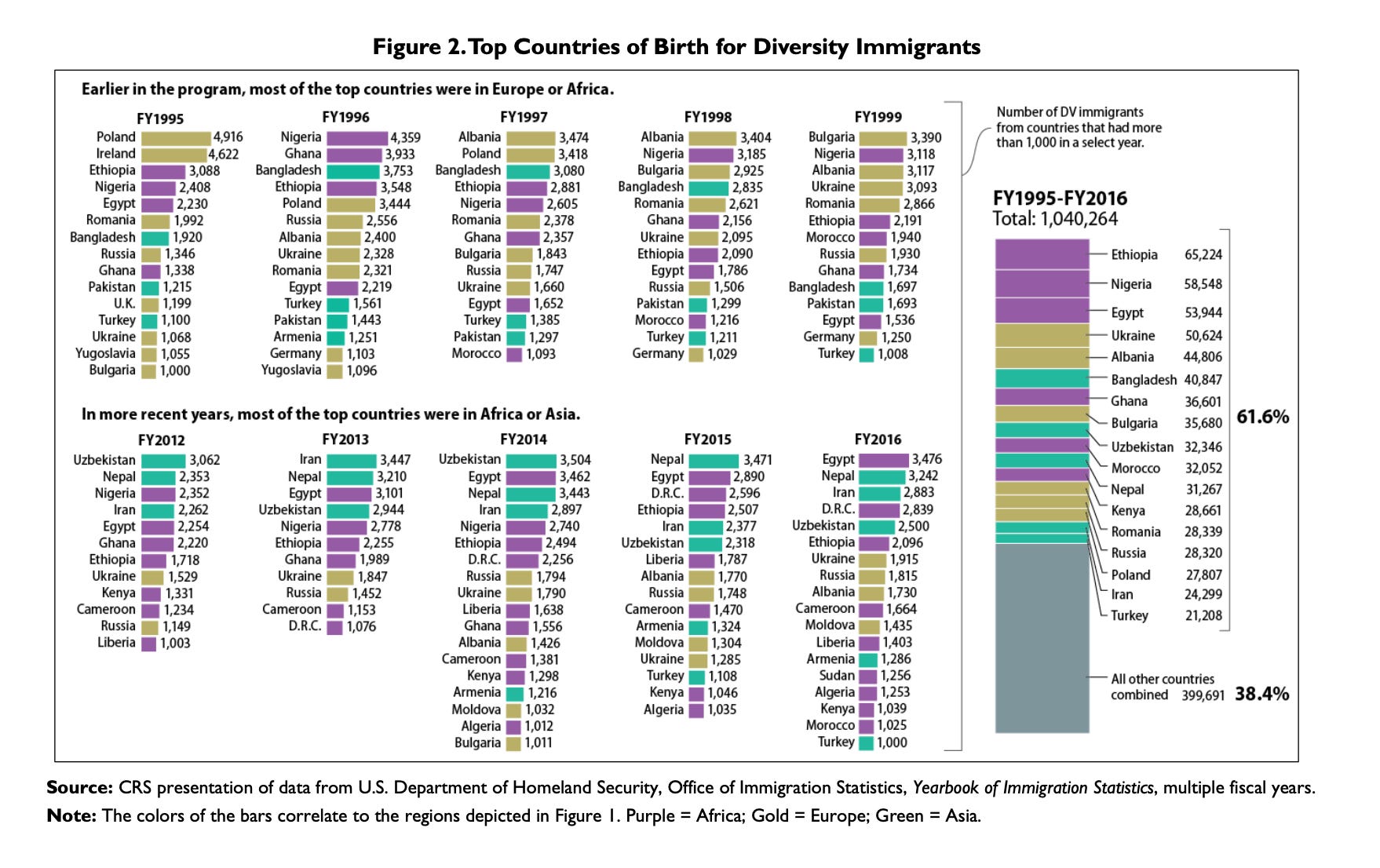
The diversity lottery introduced significant numbers of immigrants from countries that previously had little access to the American visa system. Amusingly, Senate debate referenced the diversity lottery as a way to bring in more immigrants from Ireland, Italy, and Poland. The diversity lottery is now dominated by immigrants from Africa and Asia10.
The 1990 Act also created the major non-immigrant visas used by skilled workers moving to the US (the O-1A and the H-1B)11.
No legal immigration reform bill has passed in the intervening 36 years. We still live in the world of the Immigration Act of 1990.
Conclusion
Once again, we find ourselves in a time where many people feel the US has lost control of its borders and the public tolerates harsh crackdowns on immigration.
The lesson of the 1990 Act is not that public opinion doesn’t matter, nor that political change is inevitable. Rather, the lesson is that public opinion leaves policymakers with many degrees of freedom. The Immigration Act of 1990 passed not because Americans reached a consensus on immigration, but because its architects assembled a coalition of groups that wanted very different things.
A second lesson is that you cannot build a durable politics of more legal immigration while appearing indifferent to illegal immigration. IRCA ultimately failed to control illegal immigration. But the attempt still bought Congress permission to open the front door.
Immigration feels legislatively intractable today, but that’s just because the coalition that will refashion our immigration system for the current moment has yet to be built.
“Close the back door, open the front door” isn’t a bad starting point.
Thanks to Mike, Patrick, and Pamela for comments and conversation that improved this post greatly.
This quote is from political scientist Elizabeth Hull’s Without Justice for All. Quoted in Tichenor’s definitive history of US immigration: Dividing Lines, page 242.
The chart that follows is from A Nation by Design, Aristide Zolberg, page 463.
The H-2A visa, still in use today by hundreds of thousands of farm workers annually.
In a fun bit of inter-branch finger-pointing, Simpson and Romano Mazzoli, co-authors of the 1986 bill claimed in 2006 that the IRCA legislation was terrific, and the problems all stemmed from the White House’s lax enforcement. The Washington Post on the other hand, argues that it was Congress’s fault for failing to allocate sufficient funds to enforcement.
In what is perhaps the bill’s most important legacy, the 1986 Act also created a path to permanent residency for 2.7M undocumented migrants who were already in the US.
Legalizing undocumented migrants who are already here while stopping the flow of future illegal immigration makes sense in theory. But the 1986 Act’s failures to do the latter arguably poisoned the well for similar types of approaches going forward. It’s hard to overcome the retort “we tried that in 1986 and all we did was legalize 3M immigrants, while doing nothing to close the border.”
Senator Ted Kennedy alludes to this directly in discussion of the 1990 bill, saying “[SCIRP’s] report laid the basis for the most comprehensive reforms of the Nation's immigration laws in our history. That effort has been a two-step process. In 1986, we enacted a far-reaching measure to deal with illegal immigration. In this bill, an equally far-reaching reform of legal immigration will be achieved.”
For example, senators cited the Workforce 2000 report on labor market needs, which argue that the new century required “more, better-educated immigrants to help staff a growing economy.”
The data for the following table comes from U.S. Department of Homeland Security, Office of Homeland Security Statistics, Yearbook of Immigration Statistics (2003 table 4, 2013 table 6, and 2024 table 6).
Meaning people who get permanent residency in the US because they are employed in the US, rather than because they have family in the US.
For those of you playing the alphabet game along with us at home, these are the EB 1-5 employment-based green card categories.
Interestingly, a Points System was considered as a part of the 1990 Act, but was ultimately discarded, apparently due to pushback from immigrants’ rights groups who claimed that English language components were discriminatory, and labor groups who didn’t want competition for American wages.
Instead Congress mandated the DOL to complete a 3-year program to identify professions with skill shortages, with the intent to allocate green cards to individuals who could fill those positions. The DOL published proposed regulations in 1993 which got further pushback from labor organizations and so the skill list was never implemented.
I now hear proposals that the US should pursue European immigrants to the exclusion of others because of the superior “culture” of Europe. Odious as I find this line of argument, it is still a sign of progress that “Europe” is the unit of analysis. You just don’t really hear people discriminating against Irish, Italians, or Poles the way they used to.
The following table comes from the Congressional Research Service.
Compared to its predecessor, the H-1, the H-1B focuses on professionals (not entertainers and unskilled workers) and doesn’t require firms to attempt to recruit an American before hiring. A major failure of the H-1B is its vulnerability to exploitation by outsourcing companies.
Love your article Luke! 36 years is too long. Great job laying this out in such a clear and detailed manner 😎