
I recently moved from Nairobi to San Francisco. I’ve been thinking a lot about how much more productive I am here vs there.
Because the US is WAY more productive than Kenya.
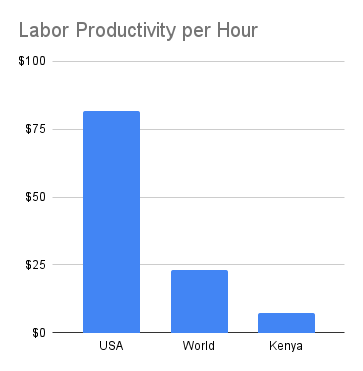
The average US worker produces $82 per hour, vs $7 per hour in Kenya and $23 per hour globally.
The US is very good at turning 1 hour of work into $82 worth of stuff that other people value. This matters.
To state the obvious: The the US’s ability to act as a global political leader, produce culture consumed all over the world, and provide a high standard of material well-being to its citizens is predicated on the material abundance that 3x productivity gives you.
On the flip side, Kenya’s relative lack of ability to manpower into stuff means low wages, high unemployment, and being reliant on donors for 30%+ of healthcare spending.
Economic productivity obviously isn’t everything. But it matters quite a lot. And I’ve been struck by the extent to which I can viscerally feel my productivity increase having moved from Nairobi to San Francisco.
Some illustrative comparisons.
Internet and electricity
In San Francisco the internet cut out during my second month on the job. The first time it happened my co-workers were like “ah this is annoying.” The second time everyone said “this is intolerable, we are immediately upgrading the internet.”
In Nairobi you cannot just upgrade the internet. The entire Safaricom network goes down at least once per week1. The competitors aren’t any better.
Similarly, when the power goes out at night (which isn’t rare), that means a salesperson can’t charge her phone at night and can’t do her job the next day2.
Safety
In Nairobi I once got mugged biking home from work, and our salespeople worried about having their phones stolen while going door-to-door.
San Francisco is nowhere as safe as it should be3, but the thought “will doing my job put me in physical danger today?” has not crossed my mind at all here.
Nature of selling services vs goods
In both Nairobi and San Francisco I’ve been working in sales and go-to-market.
In Nairobi this meant selling flour in low-income neighborhoods.
In San Francisco this means selling visa prep services to the world’s top tech talent.
I can now make more sales in one hour than our 20+ person sales team (plus a couple hundred gig workers) would sell in a day.
Put simply, this is because what we are producing at Lighthouse (high-quality visa preparation) is far more economically valuable than what we produced at Kapu (more efficient supply chain for groceries).
Productivity investments
Productivity compounds. Because I am able to produce so much per hour, it is worth investing into my productivity. Things like:
A nicer phone
Standing desk and second monitor
ChatGPT and news subscriptions
Outsourcing everything that doesn’t make our beer taste better (data pipeline work, SEO optimization, etc.)
It’s hard to justify expensing a $20 per month ChatGPT pro subscription when you are only producing $7 per hour - is the incremental pro benefit really worth 3 hours of your time per month?
When your productivity is $80 per hour, it’s a no brainer.
Conclusion
Clearly my environment and mindset in San Francisco are much more conducive to translating 1 hour of my time into high-economic-value stuff.
Economic value is important.
But obviously it’s not everything. I’m very aware of the fact that many of our customers at Lighthouse are building B2B SaaS, which they sell to companies like Lighthouse. So there is some recursion here. Whereas at Kapu, I was directly contributing to poor people saving money on their everyday purchases.
How do I think of fundamental value of what I’m producing at Lighthouse vs. what I produced at Kapu?
That might be a post for another time. For now, it’s Monday morning, and I’ve got to get to work.
Seemingly often when it rains
The power at my home also went off at least once per week, and I didn’t get cell reception in my concrete Nairobi apartment. So if I wanted to get work done at home I had to climb up 8 flights of stairs and hotspot myself from the roof.
And foreigners often overestimate how dangerous Nairobi is