
As I mentioned in my last post, roughly 20% of human experience has been lived by stateless nomadic people.
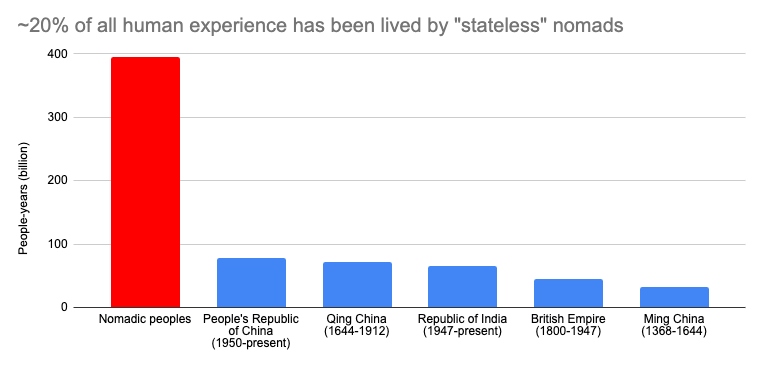
I wanted to understand the data on human settlement a bit better. Here’s what I found1:
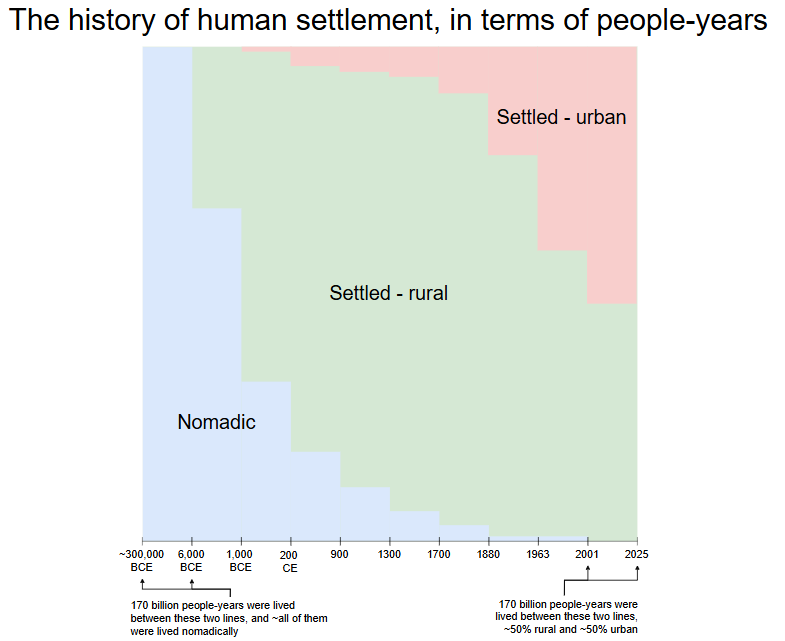
Some takeaways:
The entire first decile2 of human experience was lived almost exclusively nomadically.
By about 1,000 BCE, settled civilization was in full-swing globally, and the great majority of people were settled.
However, a decent chunk of humanity remained nomadic till the 1800s when people around the world adopted3 settled life.
Urbanism exploded in the 1900s, and since 2001 over half of human experience has been lived in cities.
Cool. So what?
I suspect that seeing charts like this either moves something in you, or it does not.
I find great drama in the grand sweep of human history. I find it exciting to reflect on the fact that half the kids no longer die, and that a majority of people live in urban environments that hardly existed 300 years ago.
I also find that reflecting on these facts gives me a lot of peace. When I’m stressed out about my city life and first-world problems, I take great comfort in being reminded that most of human experience has been lived in circumstances utterly foreign to me.
Every single person’s life has immeasurable value, and most of those lives are not very much like mine or yours at all. Rejoice, for this means that your problems are utterly incomprehensible to the vast mass of humanity that has gone before us.
Nomad data comes from Fischer-Kowalski et al., and urban data comes from Old Reliable, which itself cites HYDE. It’s hard to parse exactly how rural vs. urban is defined in HYDE. Best I can tell from a quick look is that rural = farmland plus dispersed villages, hamlets, and low-density countryside settlement.
Which, remember, took 300,000 years. People are old, man.
With varying levels of at-gunpoint-edness