
“Talent is more important than ever.”
This is a truism that you see repeated both by hiring managers on LinkedIn, and by folks working in labor mobility.
In this post I want to sketch out some intuitions as to why this is the case.
AI is a general-purpose technology
A general-purpose technology is one that gets used as an input across most of the economy (like steam, electricity, or the computer) so improvements to it ripple into nearly every other sector.
We are in the midst of the development of AI as a general-purpose technology. Many people in the economy are enabling, directly or indirectly, the AI boom. All of those people have the impact of their work amplified across the entire economy, because they are ushering in a technology that will be used by almost everyone in one form or another.
There are many steps in the chain to build and deploy AI. Top AI researchers developing the models. Chip designers and the electrical engineers installing machinery at fabs and data centers. The construction crews and tradespeople building out the grid capacity to power them. The lawyers and lobbyists clearing energy permits. The IT teams at Fortune 500 companies who are implementing AI tools for their companies.
Bottlenecks at any one of these steps can make the entire technology, and therefore the entire economy, less effective1. So the returns to having top talent in roles all across the value chain are higher than they are in normal times.
Fast diffusion + time-sensitivity makes talent even more valuable
Imagine we have two general-purpose technologies undergoing development: Robotic Armadillos and Bison.
Both are incredibly useful general-purpose robotics technologies that will increase the economy’s output from $20T to $30T once fully developed and deployed.
Each technology will take 5 years to develop.
The time it takes for the actual technology to diffuse across the economy varies:
Robotic Bison take 40 years to diffuse across the economy, because they are heavy, slow-moving, and resemble untamed agricultural equipment.
Robotic Armadillos take only 10 years to diffuse, because they are nimble, cheap, and extremely charismatic.
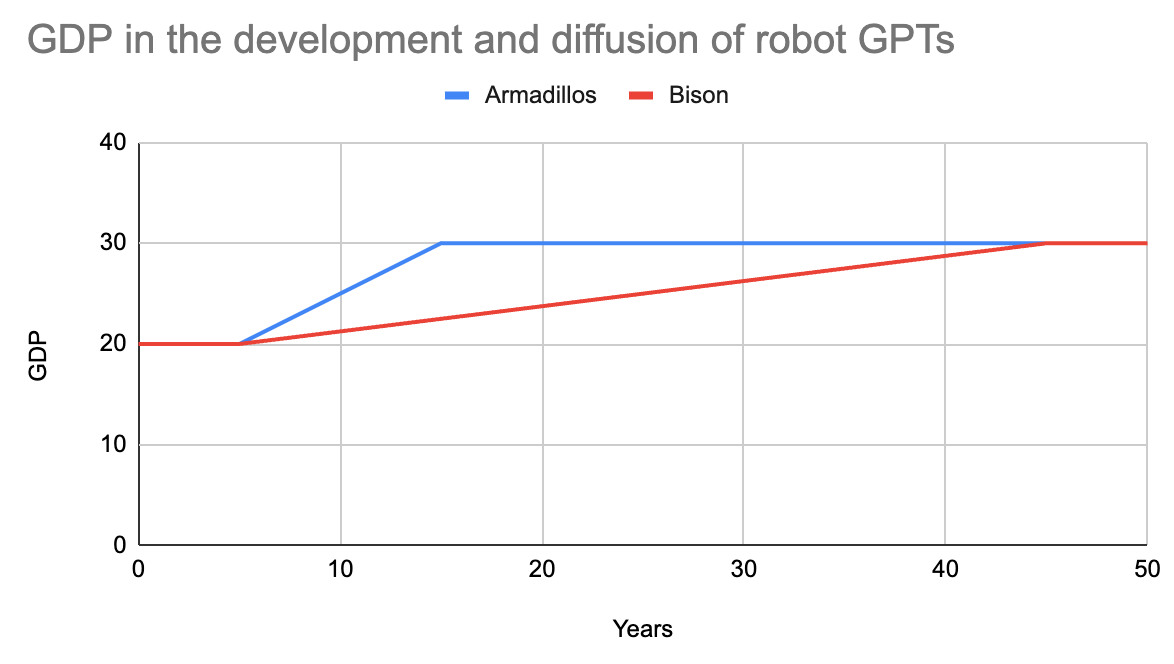
during the first five years of development, GDP doesn’t change. Then it increases linearly from 20T to 30T as the technologies are diffused Diffusion happens much faster for Armadillos vs. for Bison.
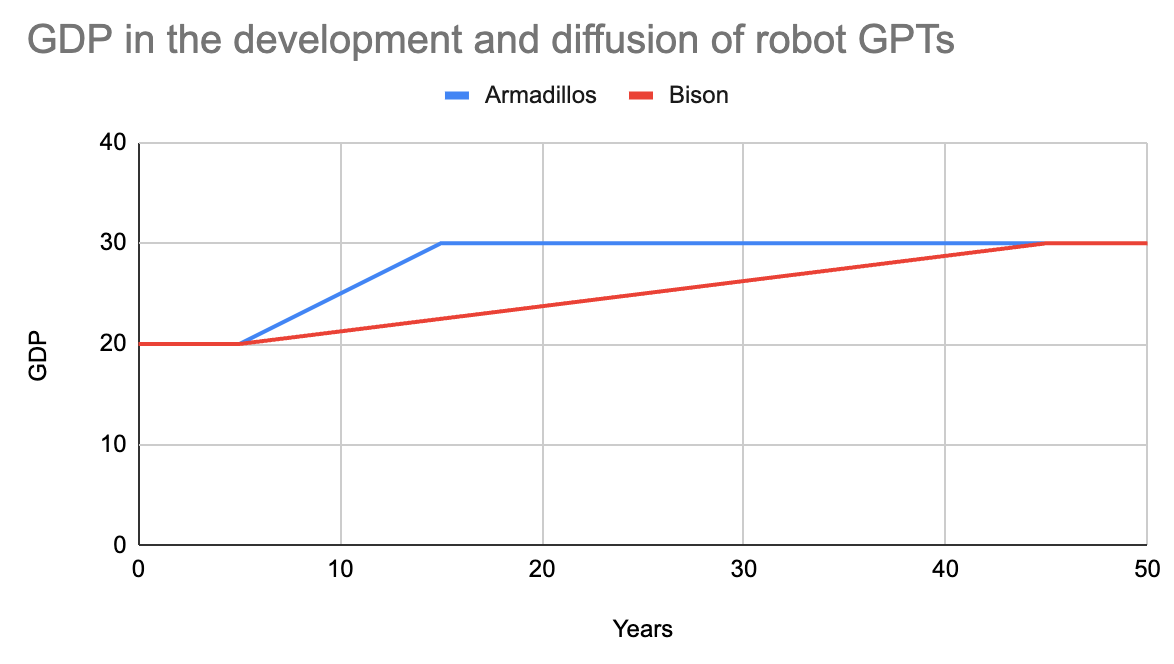
Now: Assume you have the ability to hire a bunch of super talented researchers who can speed up the development of robot technology from 5 to 4 years.
Should these researchers work on Armadillos or Bison?
The short answer: since the full impact of the Armadillos lands sooner, and since we typically discount future value (say at 7%), it is significantly more valuable to put the best researchers on Armadillos rather than Bison.
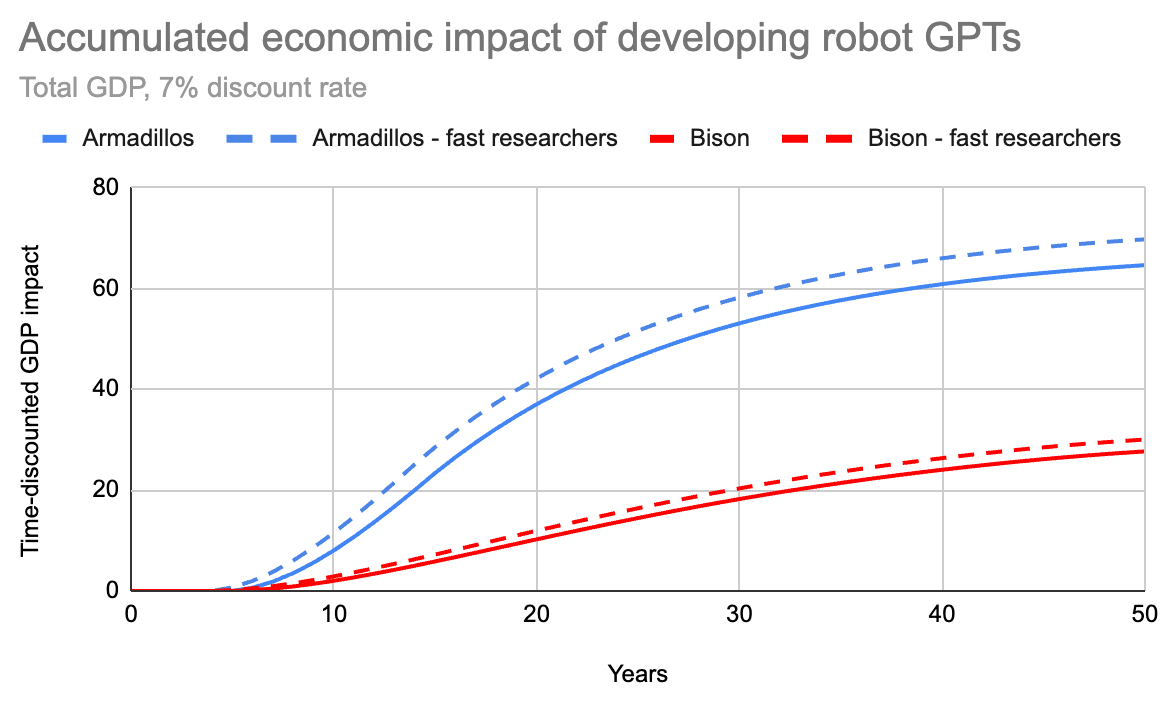
The math works out to that you get roughly $5T of extra value from speeding Armadillo development by a year, vs. only $2T from speeding Bison.
But perhaps all this math wasn’t quite necessary. The general intuition here is simply: If you have preference for things happening sooner rather than later, then have your talented people to work on technology that will cash out sooner.
The analogy here is: If AI diffuses much more quickly than previous general-purpose technologies (like electricity), then the returns to talent in the development of AI are higher than they were in previous GPT transitions, even if the ultimate economic impact of the two technologies is the same.
Deploy talent into regulatory bottlenecks
Talent is not only increasingly important in the development of general-purpose technologies, it’s also especially important in sectors where there are particular bottlenecks holding back progress.
You genuinely want to deploy talent where there are bottlenecks. And these bottlenecks don’t necessarily have to be technical or economic: They may also be regulatory or systematic.
To pick a couple of favorite causes in the progress studies space:
Medicine is gated by the regulatory apparatus around clinical trials2.
Housing is gated by zoning rather than structural engineering3.
This means that to meaningfully improve medicine and housing in society, the marginal top-talented person shouldn’t go build molecules or houses per se; rather they should focus their talent on movement-building, navigating bureaucracy, and getting the rules changed.
The societal returns to extreme talent in navigating these fields are enormous, because the obstacles being moved are what’s holding back enormous public goods.
Conclusion
Inter-company and international competition for technical talent are an outcome of talent’s value during general-purpose technology development. And we can unlock massive public goods by deploying talent towards regulatory bottlenecks.
Ultimately I find this is an incredibly affirming and exciting way to think about the problems we face as humanity. We have so many of them, and we should be absolutely unleashing talented and hungry people at them.
There has never been a better time to become an ambitious and talented person. And if you are ambitious but not yet talented, then deploy your ambition towards becoming talented!
To pick a particular infuriating example: TSMC delayed its $40B Arizona fab citing a shortage of skilled American workers; the US is short ~67,000 semiconductor workers.
A Wharton/NBER work estimates a regulatory “zoning tax” of ~34% of house value in LA and as much as 50% on Manhattan condos; if the US housing stock had kept its 1980–2000 expansion rate, we’d have 15 million more units today.