

Jack Despain Zhou (Tracing Woodgrains) had a great article this week on what he calls Chabuduo World, in which he worries about what competent AI means for humanity.
He summarizes:
“my essential point is that many skills that take thousands of hours to hone properly will find themselves with many fewer devotees. As AI capacity flourishes, human capacity in many domains will wither.”
I believe this point relies on a fundamental underestimation of human agency.
He is not alone in making this point that technology has the potential to disable us. My favorite articulation of this concept is John Campbell’s 1934 short story Twilight, about a scientist who travels 7 million years into the future and encounters a world maintained by miraculous machines. The remaining humans live helplessly in the machines’ shadow, having forgotten how they work.
“Can you appreciate the crushing hopelessness it brought to me?... to see those wondrous machines, of man’s triumphant maturity, forgotten and misunderstood. The wondrous, perfect machines that tended, protected, and cared for those gentle, kindly people who had forgotten.
They were lost among it. The city was a magnificent ruin to them, a thing that rose stupendous about them. Something not understood, a thing that was of the nature of the world. It was. It had not been made; it simply was. Just as the mountains and the deserts and the waters of the seas.”
I do not believe we are headed towards the worlds of Chabuduo or Twilight. The idea that we will relegate excellence to the realm of machines is not consistent with our previous choices in the face of technological change.
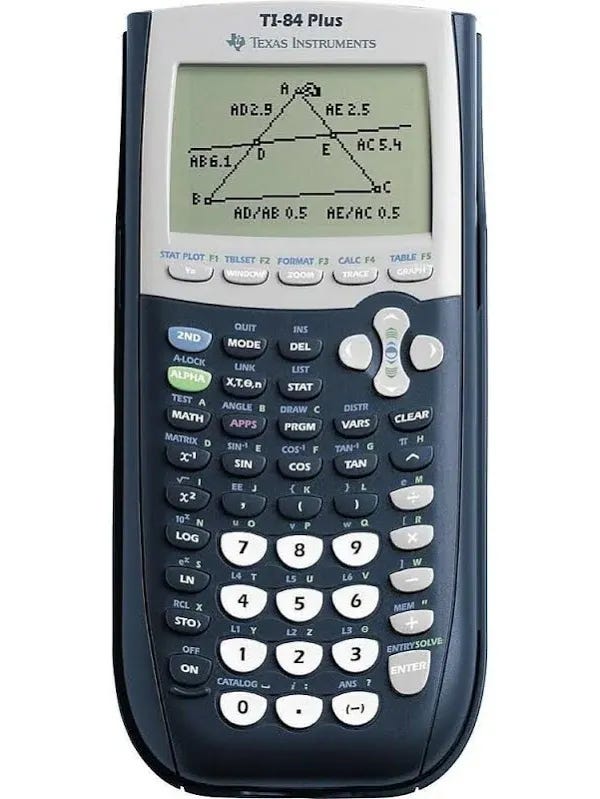
I remember clearly the feeling of pride upon being told by my dad at age 11 or 12 that I could now use a calculator in my homeschooled math work. I had mastered addition and multiplication, and my effort was now to be focused on algebra.
Similarly, upon entering high school, I was bequeathed a TI-84 graphing calculator. Having traced enough parabolas by hand to understand how they worked, it was time to devote my energy to the higher pre-calculus tasks of logarithms and conic sections.
Skill-building requires practicing the basics, even when those basics are easily performed machines. We write essays that could easily be plagiarized, lift weights that could be moved by machines, sail boats that could be powered by motor.
AI does not fundamentally change the nature of skill-building1.
Nor does automation eliminate the human desire to master craft. We know this because people often pursue excellence in skills that have absolutely no utility.
To take just one example that Tracing Woodgrains brings up in his own article: Chess. Chess is hard, taking thousands of hours to master. It is also a domain where computers have learned to play near-perfectly over the past few decades. Despite this, there are 2,000 chess grandmasters today vs. only 100 half a century ago. People choose to pursue chess excellence for its own sake2.
My faith that we will avoid lumbering into obsolescence is not blind faith that “things will just work out.” We must choose to maintain our agency.
It is absolutely true that, right now, students who use AI learn poorly and that professionals send sloppy AI-composed emails. We will need to adjust our institutions.
We’ve already started: Schools are shifting to pen-and-paper exams, companies are implementing AI-use policies, we are setting norms around acceptable uses of AI in the public and private spheres in real-time.
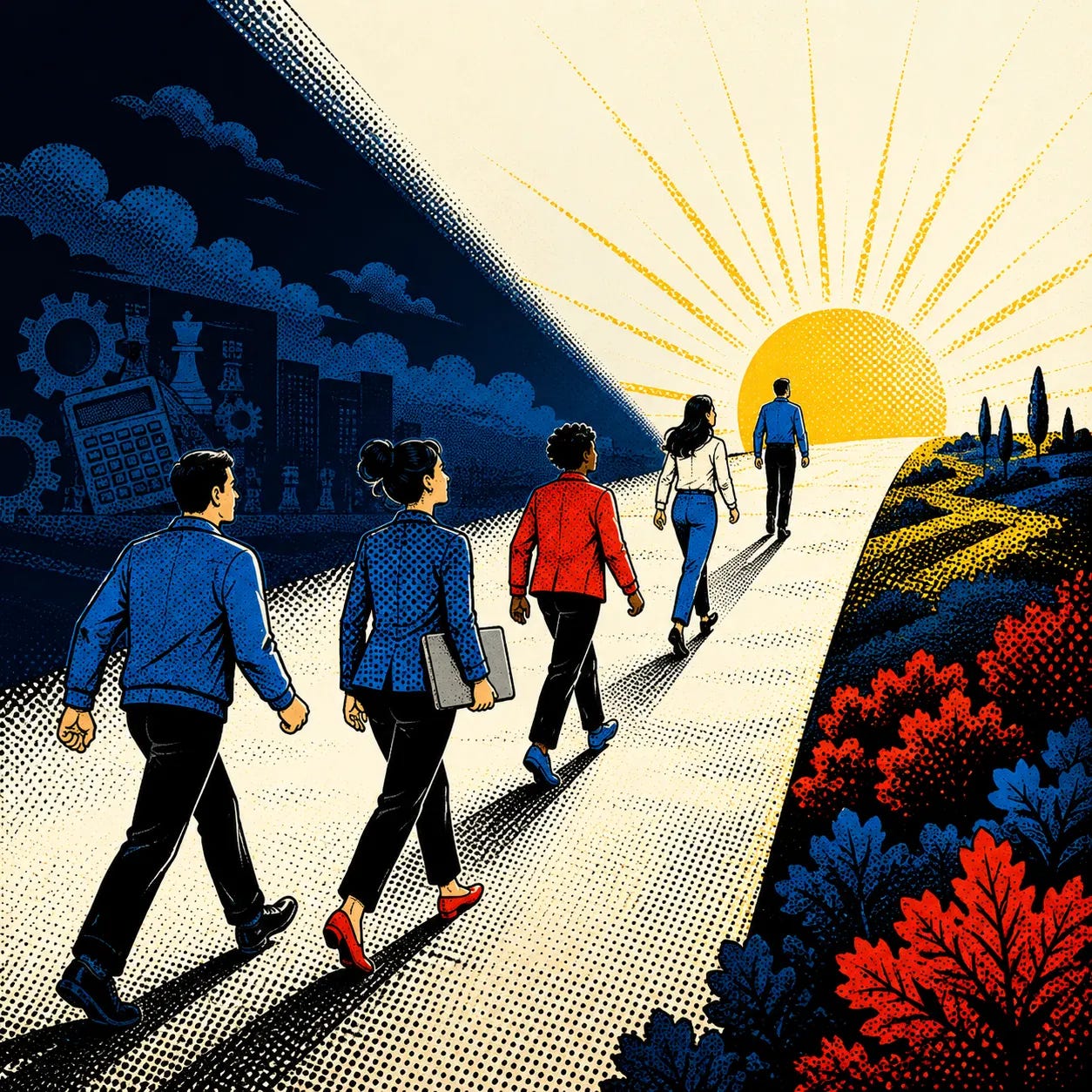
The concerns raised by Tracing Woodgrains and Campbell are valid and worth considering as warnings about the dangers that lie ahead. But ultimately I do not believe the worlds of Chabuduo or Twilight will come to pass. Because rather than sleepwalking into twilight, we will choose to stride - or at least stumble - into the brightness of the dawn.
For more on this topic, Samantha Watkins has a great article on how AI does not make education obsolete.
Sports are another obvious example. There’s absolutely no utility in being able to run a mile under four minutes, or run a marathon under two hours, but people pursue athletics as an end in itself.
Well said! You might like this post that stuck with me, over a year old but picks up the theme of human desire to master craft and self (though perhaps not a universal one ) https://barsoom.substack.com/p/the-class-of-2026