
Most people think the Industrial Revolution was about machines. Economics Nobel-laureate Joel Mokyr argues it was about epistemology.
In Gifts of Athena he makes the case that around 1800 there was a phase change in our ability to generate “useful knowledge”1.
I think it’s quite a compelling take. In this post I try to make this argument digestible.
1.
There are two types of knowledge:
Ω = propositional knowledge. In everyday language, we call this type of knowledge “facts”. For example “fire is hot”, “iron comes from the ground”, “the earth is a sphere.”
λ = prescriptive knowledge. This is the knowledge of “how”, these are techniques and technology that get things done. The ability to rub sticks together to make fire, to smelt iron ore, or to navigate using the stars are all examples of λ-knowledge.2
2.
λ-knowledge is often based on Ω-knowledge. Techniques can be generalized more effectively when grounded in understanding of underlying principles.
But any technique’s basis in propositional knowledge can be narrow (based on only very tenuous understanding) or wide (based on extensive knowledge)3.
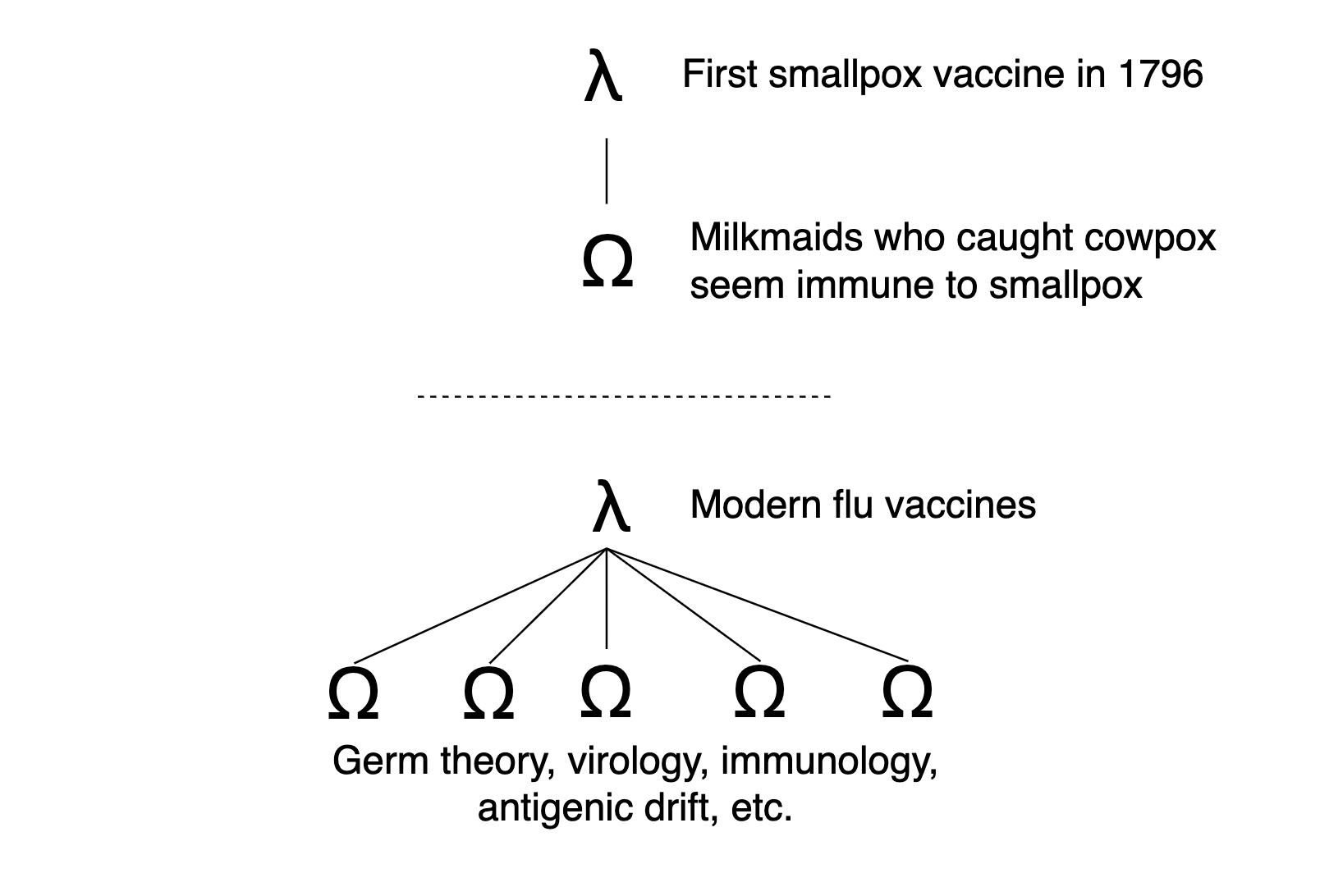
3.
λ-knowledge can also create new Ω-knowledge. Practical technology generates new understanding of the world.
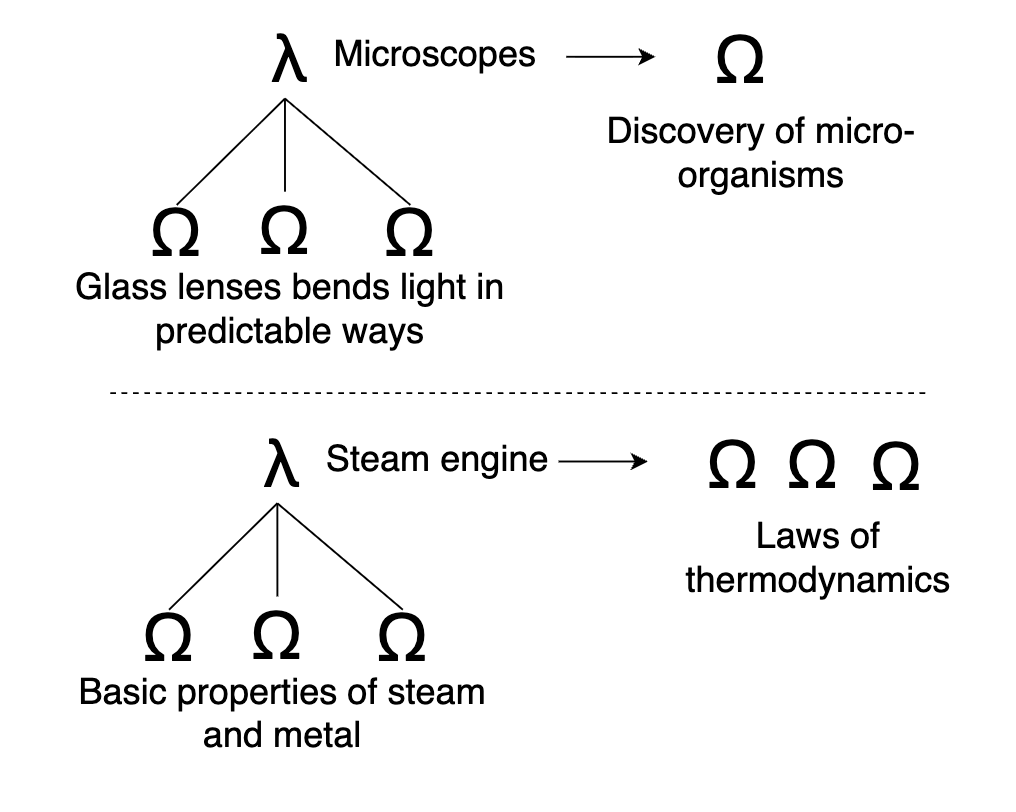
4.
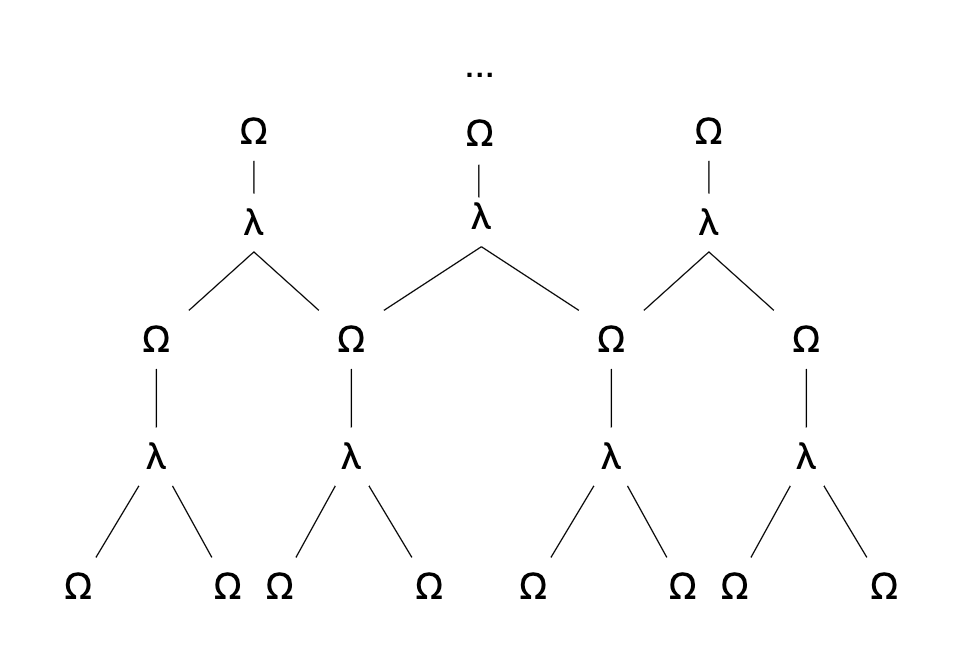
This is great! Since learning more facts (Ω) lets you build more technology (λ), and new technologies let us discover more facts, then we should be able to create a self-sustaining positive feedback loop.
5.
A self-sustaining feedback loop between Ω and λ is not automatic.
Medieval and ancient peoples invented things all the time, but we did not see rapid and sustained economic and technological growth until the 1800s. Discoveries don’t always kick off consistent, self-sustaining growth4.
This is because societal conditions can hinder the ability of Ω and λ to generate each other.
Lack of consensus on grounds for knowledge: If people don’t agree on methods of producing knowledge (e.g., if some think knowledge comes from experience while others think it must come from divine revelation), Ω-knowledge won’t be accepted or spread.
Lost knowledge: If knowledge isn’t written down or codified, it can die with its owner.
Lack of access: If access to useful knowledge is limited (e.g., through limited literacy), it won’t diffuse broadly.
Norms: If there aren’t norms and resources incentivizing understanding why a technique works, λ-knowledge stays narrow and disconnected from Ω.
6.
The industrial revolution was a result of a phase change in the generation of useful knowledge.
In the centuries preceding the industrial revolution, the right institutions and culture developed, allowing the feedback loop between Ω and λ finally became self-sustaining in the late 1700s.
Mokyr emphasizes a few forces here:
Epistemic consensus: Scientific societies established shared standards for how knowledge is produced and validated, so Ω-knowledge could spread with authority.
Knowledge preservation through institutions: Universities, publishers, and laboratories gave knowledge a permanent home, and the “Republic of Letters” ensured that learnings were shared across borders.
Access to useful knowledge: Encyclopedias, printed manuals, public lectures, and correspondence networks dramatically lowered the cost of accessing both Ω and λ knowledge.
Industrial Enlightenment Norms: A cultural shift in which educated elites began taking technology seriously as a subject of scientific inquiry, creating norms that incentivized understanding why techniques work.
Conclusion
We are the beneficiaries of this feedback loop. The accumulation of Ω and λ - continues today, and is the basis for our absurdly high material standard of living.
It’s up to us to keep it up. When thinking about every institution, norm, or policy, we should ask the question: “Does this make it easier or harder for knowledge to compound?”
In the long run, few things matter more.
For what it’s worth, I was pretty unimpressed when I picked up another of his books, A Culture of Growth. But then he won the Nobel Prize in economics. So I figured hey, I’m probably missing something here.
In the past few months, I also found Two Paths to Prosperity fairly interesting. It’s a book which tries to answer the question “Why did Europe overatek China economically and technologically between 1000 and 2000?
I’m glossing over some details here, such as that Ω-knowledge doesn’t actually have to be true. Beliefs about humors in the body would count as Ω-knowledge, even though we now don’t believe these to be accurate.
Narrow-based λ is hard to sell to the public, because it is not grounded in common, widely-shared Ω knowledge.
Or at least not at the rate that growth took after the industrial revolution.