

I believe that the US should be talent-maxxing. We should let the world’s most talented people move to the US and unleash their productivity for the benefit of the American citizen.
But I’m not pro-immigration all the time. There are some areas where immigration genuinely should be restricted.
Those of us who see immigration as America’s strength tend to downplay its abuses. And this makes sense sometimes: In the face of a nativist movement that demonizes immigration of all kinds, I’m happy to work my 9-to-5 shift shouting from the rooftops “immigrants are good, actually.” Simplistic messaging has its place.
But nuance also has its place. It’s worth meditating on the scenarios where our immigration system truly does have gaping loopholes.
So in an effort to break down the false “pro-immigration” vs. “anti-immigration” dichotomy, I want to go on record with three areas where I would restrict immigration. These are some of the areas where MAGA and the nativists are actually right when they say that people are hacking the system1.
1. Shut down sham Day-1 CPT
Let’s start off with the most egregious. There is a cottage industry of universities whose primary purpose is to help people get around the immigration system.
Foreign students in the US are allowed to work under certain circumstances: Think summer internships and in-semester apprenticeships.
But there is a gaping loophole here filled by a program called “Day-1 CPT”. In these programs, foreigners take minimal course work (<5 hours per week) and work 40 hours per week.
It is a way for unscrupulous schools to earn tuition money, and for people with no other visa pathway to work in the US under the guise of getting a degree.
This is fairly widespread - Bloomberg estimated 20k+ students enrolled in Day-1 CPT schools in 2022.
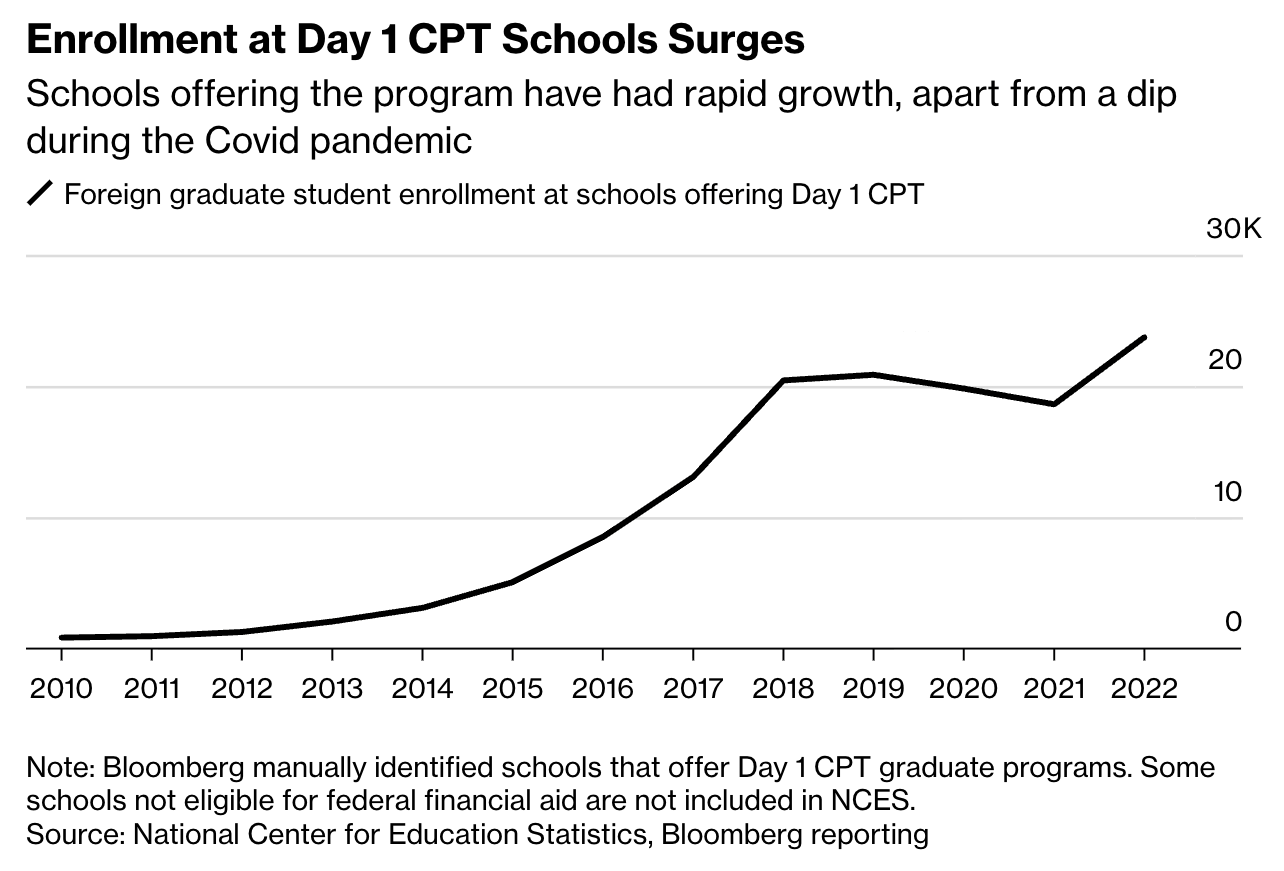
This problem has persisted for over a decade. The government is well aware of schools who abuse Day-1 CPT, and even started a fake school in 2015 as a sting operation.
The Trump administration, to their credit, has taken some action here. In August the administration warned universities that they risked losing their ability to enroll foreign students if they abused CPT. It remains to be seen how effective this crackdown will be.
2. Block the use of concurrent H-1B
The H-1B has been in the news a lot recently - the White House keeps trying to impose a $100k fee which, while somewhat effective at curbing some abuses last year, has been struck down by a federal court.
But there has been relatively little commentary on the abuse of concurrent H-1Bs to get around the H-1B lottery. So here goes.
It’s hard to get an H-1B visa if you want to work at a for-profit company: You literally have to win the lottery2.
Now here’s the trick: Some employers, such as nonprofit research institutions, are exempt from the lottery. And if you work at one of these employers, you can also get a second “concurrent H-1B” to work at a for-profit company, no lottery required.
This has legitimate use cases: Think a professor who works 40 hours a week at their university, and takes a job consulting in industry for 5 hours per week on the side.
But when your hours are inverted, this is obviously an abuse of the system. It is possible to get a 5-hour/week job at a research non-profit, and then get a “concurrent” H-1B to work 40 hours per week at a for-profit. You essentially have gotten around the lottery entirely3.
The fix here would be pretty simple mechanically: Require a more reasonable minimum number of hours (e.g., 20 / week) at non-profit roles before allowing for concurrent H-1B filings.
3. Start tracking overstays, and enforcing departures
Did you know that we don’t comprehensively track exits into the US? If you drive over the land border into Mexico, your exit does not get systematically logged by the US government.
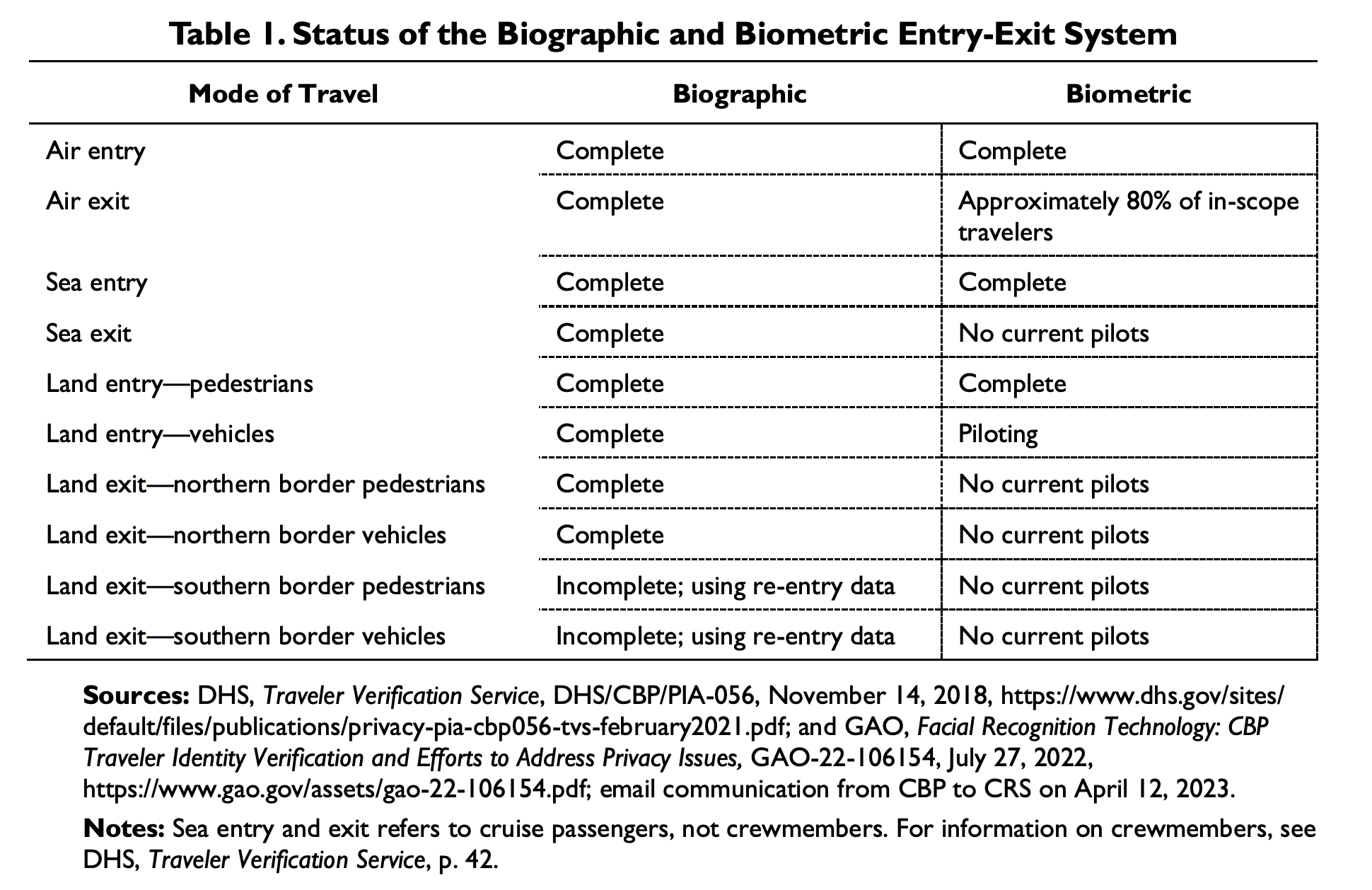
This seems ridiculous on its face. We are the richest country in the world, and should know when someone legally exited the country. Our inability to do so is one of the reasons we have a hard time tracking down people who have overstayed their visas4.
And overstays are a real issue: The Congressional Research Service reports that
On average, between 1% and 2% of nonimmigrant admissions result in an overstay each year, representing approximately 650,000-850,000 overstays annually… An estimated 42% of the approximately 11 million unauthorized population living in the United States entered the country legally but overstayed their period of admission.5
You can build as tall a wall as you want, but you’ll still end up with undocumented people if you let them in the front door then don’t check that they leave on time.
Conclusion: Hate the game, not the player
I understand immigrants are responding to the incentives of a restrictive immigration system. The American dream is worth chasing, visa options are limited, and Day-1 CPT and concurrent H-1Bs are technically legal6! Immigrants are people too, and who among us has not tried to exploit a legal loophole?
These are systemic policy and enforcement issues. Imagine, if you can, a White House serious about patching them - at effectively restricting obvious abuse. We have not had such a White House recently.
We shouldn’t approach immigration issues from a binary “pro-immigration” or “anti-immigration” lens. We can be a beacon of light to the smartest people around the world, without the loopholes.
For the avoidance of doubt: I speak for myself, not my employer, and actively steer people away from pursuing Day-1 CPT or concurrent H-1Bs, and overstaying.
The H-1B is the US’s primary skilled worker visa and they are capped at 85,000 per year. Since at more than 85,000 people want to get H-1Bs every year, we allocate the 85,000 visas by lottery. Because rolling dice makes sense as a way to pick your future citizens.
As far as I know, this is not an extremely widespread practice, because it is fairly difficult. You have to find both a nonprofit and a for-profit willing to go along with this obviously sketchy approach. It is also somewhat expensive: You face double the filing fees.
Apparently tracking land-border exits is more difficult than it seems. Even the EU only switched on an automated system logging land-border exits in 2026.
Now, to be fair, some of this is not a big deal. A good chunk of the people illegally in the country are just people who overstayed their tourist visa by a few days.
Overstaying your visa is not.