
Are the US and China locked in a fierce battle for global AI talent?
You might think so from reading headlines over the past few years.
The story goes that Trump’s immigration policies have cratered the US’s ability to attract AI talent, and that China is stepping in to fill the void: poaching Nobel laureates, and creating a new STEM visa to attract people who America turned away.
The reality is that the US remains far and away the top destination for international AI talent, especially those from China. China doesn’t need to attract much international talent because it produces over 50% of the world’s AI researchers.
Some new data from the Carnegie Endowment for International Peace helps put this in perspective.
The US still mogs the world in attracting international talent…
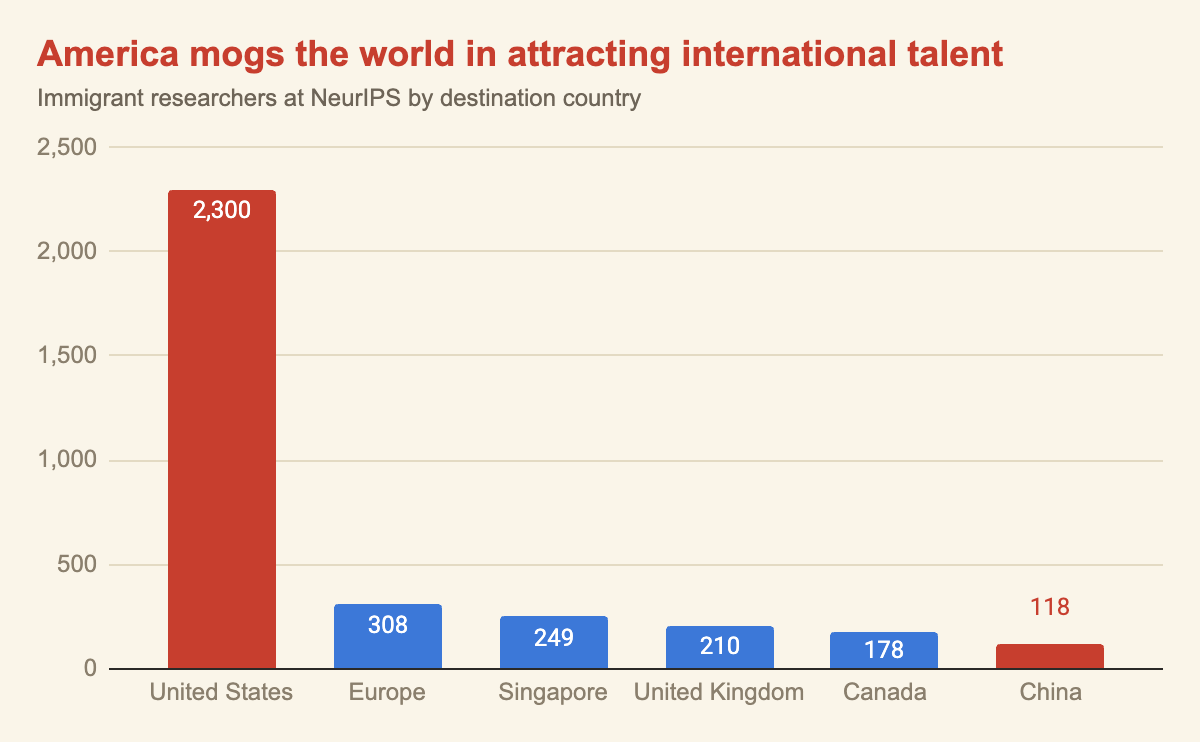
Despite occasional splashy headlines about Nobel-winners moving to China, the US still dominates competition for global talent.
This includes attracting talent from China. A full 30% of AI talent trained in China goes abroad, the majority to the US, while only ~10% of individuals going to undergrad in the US go abroad.
…but China wins at training new researchers…
China, on the other hand, produces far more researchers than any other country. Over 50% of authors in the sample did their undergrad in China.
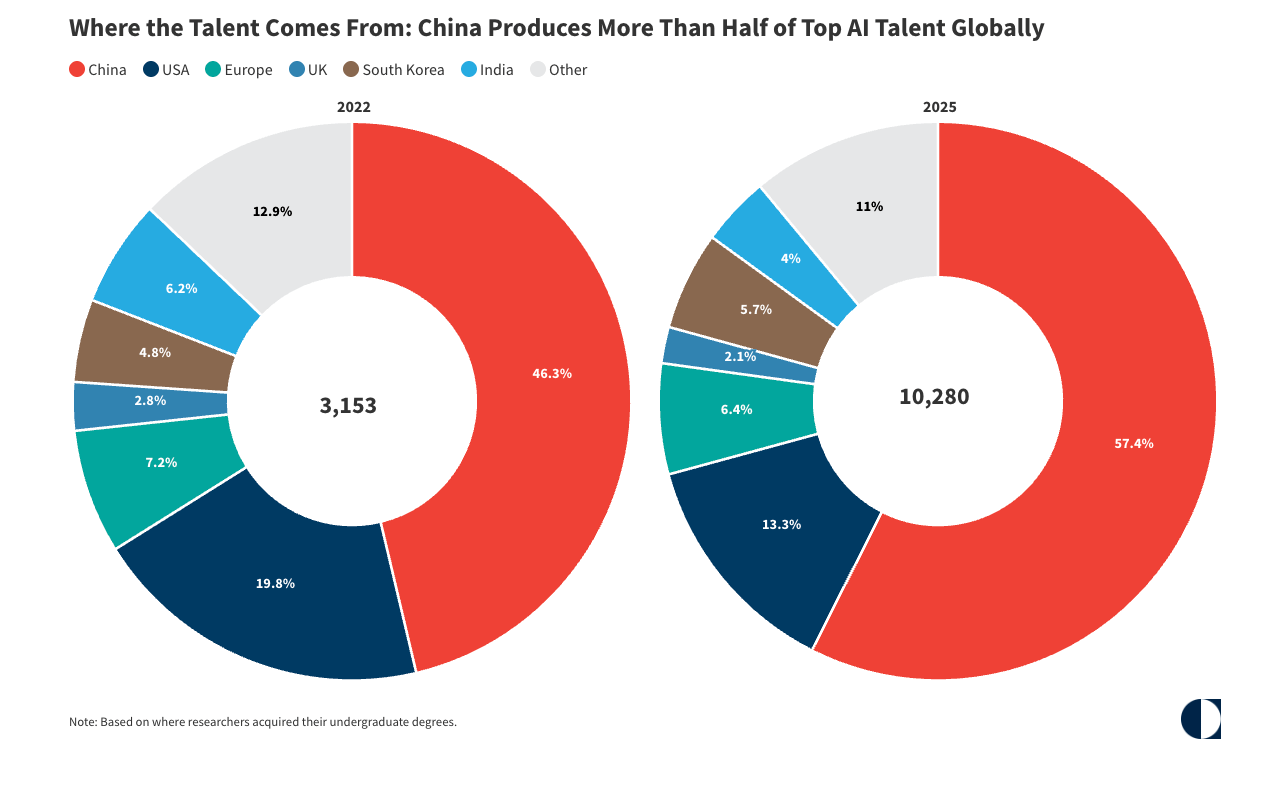
We shouldn’t necessarily be surprised here. China is a country of 1.4 billion people with a terrific education system.
In 2025, China overtook the US as the country producing the most AI research in Carnegie’s dataset, with almost zero participation from foreign researchers.
China simply doesn’t need to compete for global talent - retaining its own people are sufficient. 30% of China-trained researchers end up working abroad, but the CCP is doing what it can to bring that number down (e.g., by straight-up restricting STEM professionals from traveling abroad).
As I’ve written before, we should combat these restrictions by more aggressively stealing Chinese talent.
…and the rest of the world is quite far behind.
70%+ of AI research takes place in the US and China, at the undergrad, graduate, and post-grad levels.
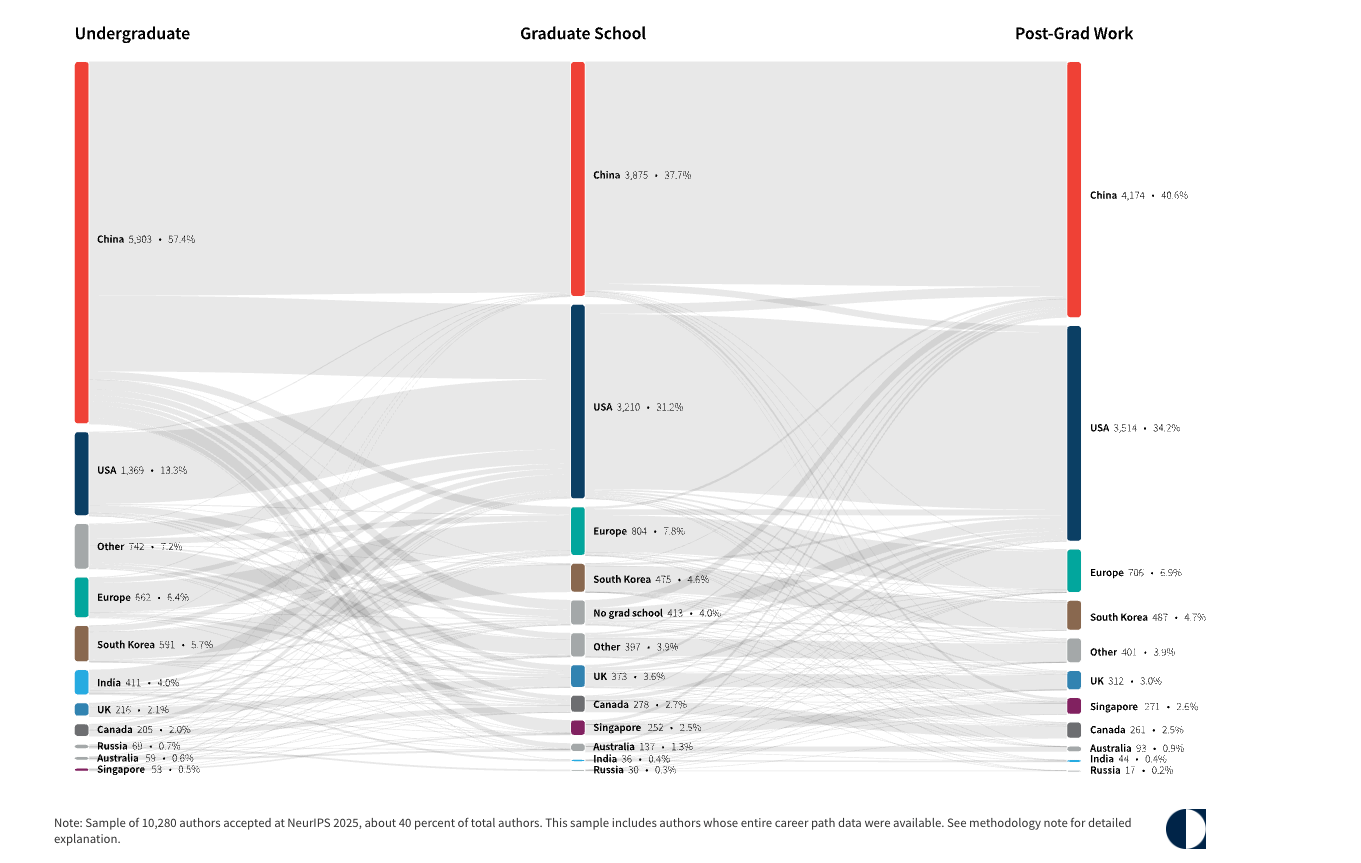
The past few years have seen some interesting shifts around the margin - in particular Singapore + Korea rising in importance - but China and the US are the dominant players in the story here1.
How much does all this matter?
Quite a bit. Top-tier talent is a rate-limiting factor to pushing forward the AI frontier, as evidenced by eye-watering salaries at AI labs, and academia’s hand-wringing about brain drain.
American employers would hire more from abroad, but are unable because of an immigration system that is fundamentally not up to the task, made worse by the Trump administration’s active attempts to scare people away.
America retains a durable talent advantage over the rest of the world for now, but we shouldn’t take it for granted. This strength could fall apart over the course of a few decades if we don’t make pathways to the US clear, predictable, and open to exactly the skilled AI professionals we need.
Every year, a new wave of AI professionals is minted abroad. Many of them would like nothing more than to build their lives and careers in the US, putting their skills at the disposal of the American people.
All we have to do is extend them the offer.
—
Thanks to Sophie Gilbert and Matthew Gammans for comments and discussion on this piece.
Some interesting tidbits on Asia.
South Korea’s talent is largely homegrown - they are second only to the US in retaining AI talent.
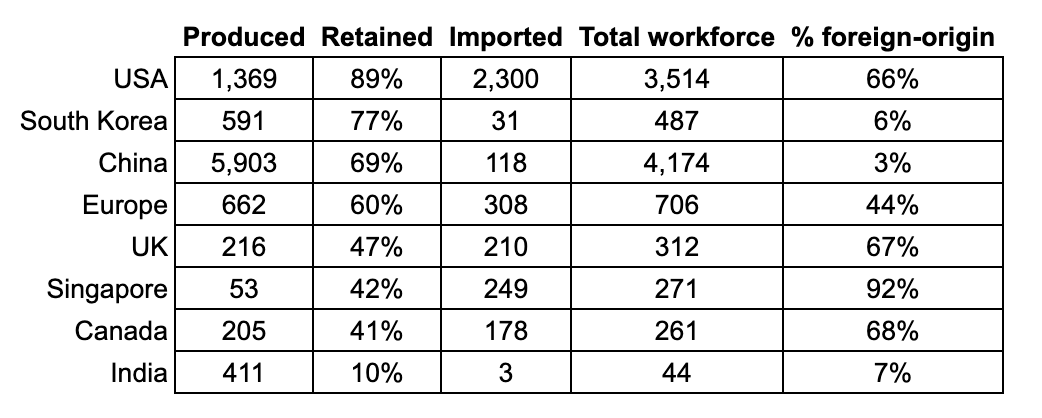
Singapore, on the other hand, largely imports graduate students from China to its flagship technical universities: NUS and NTU. Anecdotally, Singapore also serves as a sort of way-station where America-bound Chinese nationals can post up, working for US employers remotely while they wait for visa clearance to move stateside.
Japan, regrettably, is essentially a non-player in AI.