

Humankind keeps developing better methods for getting the things that matter to us.
We want to be healthy. We used to rely on folk remedies and prayers. Now we have safe drinking water and antibiotics, and we live longer than ever.
We want to understand the world. We used to rely on myth and speculation. Now we have telescopes to probe the origins of the universe, and particle accelerators to investigate the fundamental fabric of reality.
We want to love our neighbors, as Christ commands us to. For most of human history, the best you could do was to help someone nearby, or maybe pray for someone far away. But now we can do far better.
Those of us in rich countries have tools to express love of neighbor that our ancestors couldn’t have dreamed of. To take just one example - you can send money directly to people across the world.
If you’re interested shine God’s love into the world as brightly as possible, using all the intellectual and technological tools the modern world puts at your disposal, then you should check out the new book All the Lives You Can Change1.
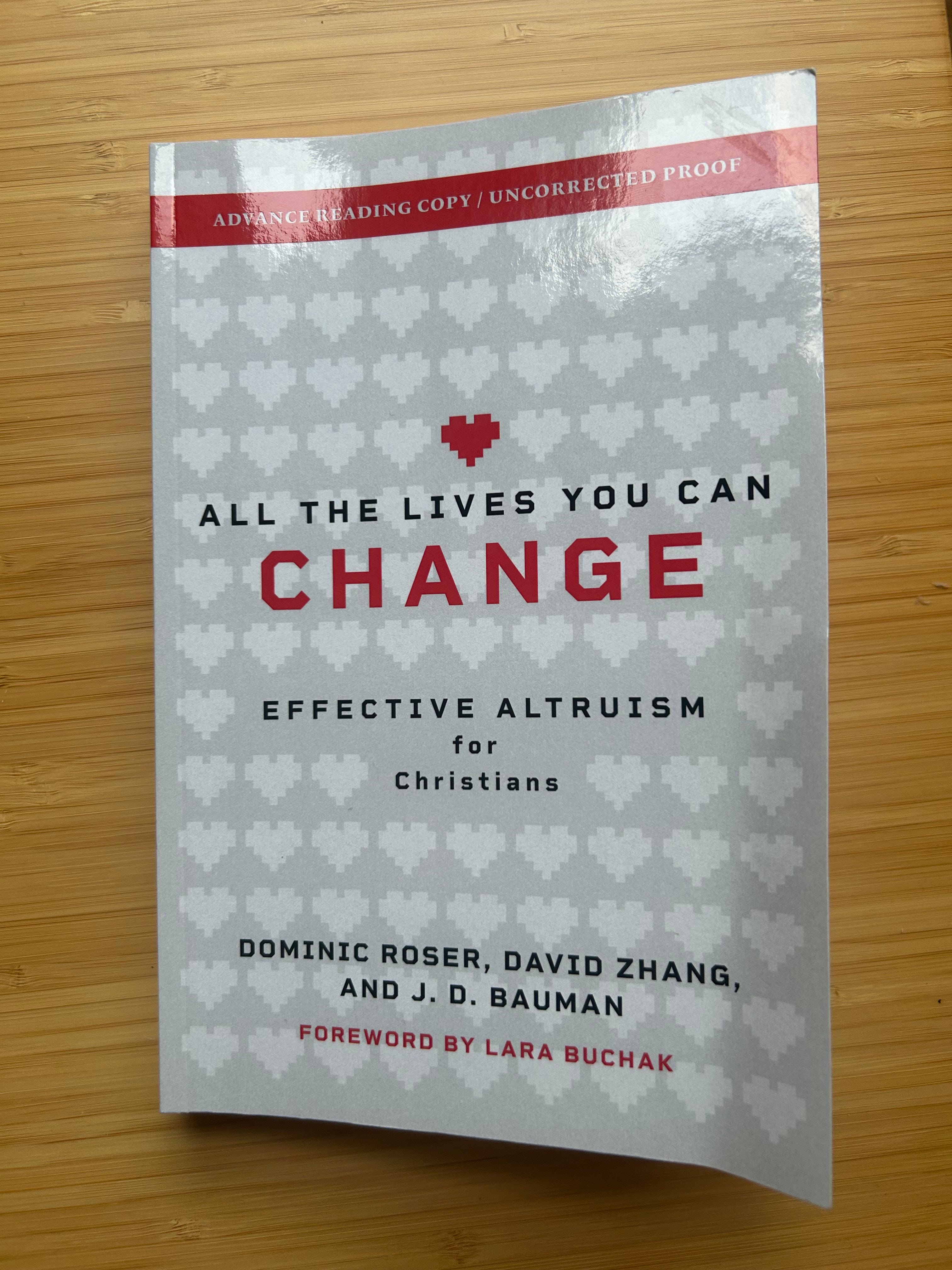
The core of the book is to ground the ideas of Effective Altruism in Christian teaching2 - and it does a terrific job. In my opinion, the best audience for this book is young Christians: People who who are alight with fire to love their neighbor and improve this broken world, but unsure of the direction they should take.
This book gives you a blueprint, rooted in Christian principles, for thinking about career choice, donations, and volunteering. It’s full of examples of inspiring people who have thought hard about what it means to “love your neighbor as yourself” in the modern world. And in some cases made enormous sacrifices to do so.
C.S. Lewis said that God wants us to have “a child’s heart, but a grown-up’s head.”
He wants us to be simple, single-minded, affectionate, and teachable, as good children are; but He also wants every bit of intelligence we have to be alert at its job, and in first-class fighting trim. The fact that you are giving money to a charity does not mean that you need not try to find out whether that charity is a fraud or not.3
Effective Altruism is, ultimately, a project about how to pursue idealistic goals without being naive.
It’s the best framework for people thinking seriously about serving their neighbors. And All the Lives You Can Change is the best introduction to the topic for Christians.
Highly recommended!
The subtitle is Effective Altruism for Christians, and the authors are Dominic Roser, David Zhang, and J.D. Bauman
Effective altruism is, at its heart, a quite important Christian project. In the west, the idea that you should love your enemies and total strangers is very much rooted in the teachings of Christ. Over the past few months I’ve been reading more classical Pre-Christian literature and have been shocked at the pre-Christian celebration of violence against innocents.
C.S. Lewis, Mere Christianity
I’m not through with the book yet, and while I do like parts of it, to be frank, so far, as with regards to the Christian case for effective altruism, I’m not persuaded, at best, and in some cases, at worst, I find it spiritually troubling. Parts of chapter 5 (which is most recent and top of mind) are a spiritual minefield man. And I’ve looked ahead and seen that there appears to be a section on the good of power and influence in this Christian book and I’m like (*nervous laughter*): oh man.
I remember being a teenager in my (Baptist) church, and asking the pastor why community aid was contingent upon church attendance/membership. They made the case that it was to prevent people from taking advantage of the programs. That didn’t sit well with me. It struck me as transactional and unnecessarily limited the scope of the aid.
As an adult, looking back, I can understand the need to protect systems of aid from those that might abuse them. But is making aid contingent upon church attendance the right way to do it? Or is it better to distribute aid unconditionally and accept some level of fraud(“forgive seven times seventy” etc)? I’m not sure.
In any case, sounds like that book might address issues like that. I certainly will check it out. Great post Luke!